

Syed Babar Ali: Pakistan’s Visionary Institution Builder
The business leader behind Packages Limited, LUMS and several important Pakistani institutions

Last Updated on July 29, 2026 by Fame Katha Editorial Team
Introduction
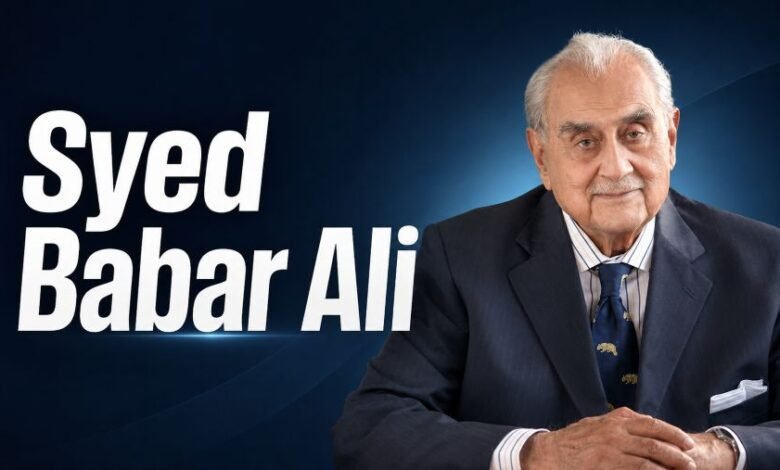
Syed Babar Ali is a Pakistani industrialist, entrepreneur, educationist and philanthropist. He is best known for establishing Packages Limited and leading the creation of the Lahore University of Management Sciences, commonly known as LUMS.
His work goes far beyond building companies. He helped improve business education, teacher training, scientific research and environmental protection in Pakistan.
As of July 2026, he is 100 years old and remains the Founding Pro Chancellor of LUMS. The university officially celebrated his 100th birthday in June 2026.
Syed Babar Ali Quick Facts
| Detail | Information |
|---|---|
| Full name | Syed Babar Ali |
| Date of birth | June 30, 1926 |
| Age | 100 years old as of July 2026 |
| Birthplace | Lahore, British India, now Pakistan |
| Nationality | Pakistani |
| Profession | Industrialist, entrepreneur, educationist and philanthropist |
| Education | Government College Lahore and Harvard Business School programme |
| Known for | Packages Limited and LUMS |
| Major public role | Former caretaker Finance Minister of Pakistan |
| Current university role | Founding Pro Chancellor of LUMS |
| Former international role | President of WWF International |
| Major recognition | International Honorary Member of the American Academy of Arts and Sciences |
Harvard Business School records his birth date as June 30, 1926. It also lists his B.Sc. from Government College Lahore and his completion of the Harvard Advanced Management Program in 1973.
Who Is Syed Babar Ali?
Syed Babar Ali is one of Pakistan’s most important business and education leaders.
He became known in the business world after helping establish Packages Limited, a packaging company founded in 1956. He later supported the creation of several businesses through partnerships with international companies.
However, many people know him most clearly for LUMS. He recognised that Pakistan needed professionally trained managers, business leaders, researchers and entrepreneurs.
Instead of focusing only on his own companies, he helped build an educational institution that could prepare future generations.
This combination of business development and institution-building made his career different from that of many traditional industrialists.
How Old Is Syed Babar Ali?
Syed Babar Ali was born on June 30, 1926.
He turned 100 in June 2026. LUMS marked the occasion by celebrating both his centenary and the university’s 40-year journey.
As of July 2026, he continues to be publicly connected with the university as its Founding Pro Chancellor.
Education and Early Business Experience
Syed Babar Ali studied at Government College Lahore and earned a Bachelor of Science degree.
He later attended the Advanced Management Program at Harvard Business School in 1973.
After the creation of Pakistan in 1947, he joined his family’s cotton-export business. At the time, much of the cotton was exported to India.
When he tried to reach customers in other countries, he noticed a practical problem. Pakistan did not have enough suitable packaging materials for international exports.
This problem helped create the idea for a local packaging company.
Harvard Business School explains that the need for stronger export packaging eventually led him towards establishing Packages Limited.
How Did Syed Babar Ali Start Packages Limited?
Packages Limited was established in 1956.
The company began as a partnership between Pakistani investors and Åkerlund & Rausing, a Swedish packaging business.
Its purpose was to produce packaging materials inside Pakistan instead of depending heavily on imported products.
The company initially focused on folding cartons. It later expanded into paper, board, flexible packaging and other products.
This international partnership also reflected an important part of Syed Babar Ali’s business thinking. He believed that Pakistani companies could learn new technology and management systems by working with experienced international businesses.
Packages Group identifies him as the entrepreneur behind Packages Limited and several other major ventures.
Which Companies Did Syed Babar Ali Establish?
Syed Babar Ali is associated with the creation and development of several companies.
These include:
- Packages Limited
- Milkpak Limited
- Tetra Pak Pakistan
- IGI Insurance
- Tri-Pack Films
- IGI Investment Bank
Many of these businesses were developed as joint ventures.
A joint venture is a business formed through cooperation between two or more companies. Each partner may provide money, technology, knowledge, workers or access to customers.
Syed Babar Ali used this model to bring international business knowledge and manufacturing technology into Pakistan.
Readers interested in another Pakistani founder who built international technology companies can explore Zia Chishti’s technology and business journey.
Milkpak and Nestlé Pakistan
Milkpak Limited was another important company connected with Syed Babar Ali.
The business worked to improve the processing and distribution of packaged milk in Pakistan. It later became connected with the international food company Nestlé.
Milkpak developed into Nestlé Pakistan Limited, one of the country’s major food and beverage companies.
His involvement with Milkpak showed how local knowledge and international experience could be combined to build a larger food-processing business.
Why Did Syed Babar Ali Help Create LUMS?
During his business and public-sector experience, Syed Babar Ali saw that Pakistan did not have enough professionally trained managers.
He believed that growing companies needed leaders who understood finance, operations, ethics, decision-making and long-term planning.
In 1983, he proposed creating a world-class management institution in Pakistan. A group of founding members established the National Management Foundation in 1984 to support the project.
LUMS received its university charter in 1985. Syed Babar Ali became Pro Chancellor in 1986.
According to the official history of LUMS, the institution started its operations in a small rented building. It later developed into a large university with schools covering business, science, engineering, law, education, humanities and social sciences.
How Did LUMS Develop?
LUMS began mainly as a management-education institution.
The first MBA class graduated in 1988. The university introduced case-based teaching, which allows students to study real business situations and discuss possible decisions.
The institution later added undergraduate programmes and expanded into other academic fields.
In 2002, Syed Babar Ali began promoting the idea of a science and technology school at LUMS. He believed that Pakistan needed researchers who could create new knowledge and technology.
Classes at the School of Science and Engineering began in 2008. In 2012, it was renamed the Syed Babar Ali School of Science and Engineering.
His educational work therefore moved beyond management training. It also supported scientific research, engineering and technological development.
Ali Institute of Education
Syed Babar Ali founded the Ali Institute of Education in 1992.
The institute was created to improve the training of primary- and secondary-school teachers.
Teacher training can have a wide effect because one well-trained teacher may educate hundreds or even thousands of students during a career.
The institute reflects his belief that a country’s development depends on improving education at several levels, not only at universities.
Government Service
Syed Babar Ali also served in the Government of Pakistan.
In 1993, he worked as Minister of Finance, Economic Affairs and Planning during a caretaker administration.
A caretaker government normally manages the country for a short period while preparations are made for a general election.
His government position was temporary, but it added public service to his long career in business and education.
Work With WWF
Environmental protection is another important part of his public work.
Syed Babar Ali supported the World Wide Fund for Nature, commonly called WWF, for many years.
He served as President of WWF International from 1996 to 1999. He succeeded Prince Philip, Duke of Edinburgh, in the international position.
Packages Group currently describes him as Vice President Emeritus of WWF International and President Emeritus of WWF-Pakistan.
His work with WWF connected Pakistani business leadership with international environmental conservation.
Babar Ali Foundation and Public Support
The Babar Ali Foundation was established in 1985.
Its work has mainly supported education and healthcare projects in Pakistan.
Packages Group states that the foundation provides financial support for educational and health-related causes. He has also been associated with charitable and medical organisations, including Shalamar Hospital in Lahore.
His approach to philanthropy focused on creating and supporting institutions rather than only providing short-term assistance.
International Recognition
In 2020, Syed Babar Ali was elected as an International Honorary Member of the American Academy of Arts and Sciences.
The Academy placed him in the field of business, corporate and philanthropic leadership.
Its official profile recognises his work as a Pakistani business leader, former finance minister and supporter of higher education.
He was formally inducted with the Academy’s 2020 group during a ceremony held in 2022 after pandemic-related delays.
He also received an OBE from Britain in 1997 and an honorary Doctor of Laws degree from McGill University in the same year.
What Is Syed Babar Ali’s Current Role?
As of July 2026, Syed Babar Ali is recognised by LUMS as its Founding Pro Chancellor.
He continues to appear at university events and remains publicly connected with the institution’s values and development.
LUMS celebrated his 100th birthday on June 10, 2026. The event brought together faculty members, donors, university leaders and other members of the LUMS community.
The celebration focused on his role in developing the university and supporting access to high-quality education.
He should be described as the founder of Packages Limited rather than its current chief executive. The company’s present management is handled by a newer generation of business leaders.
What Can Entrepreneurs Learn From His Career?
Syed Babar Ali’s career offers several simple lessons for business founders.
Solve a Real Problem
Packages Limited grew from a clear need. Pakistan required better packaging for locally produced and exported goods.
The business was not created around an unclear idea. It addressed a practical problem.
Learn From Experienced Partners
He worked with international companies to bring new technology and business knowledge into Pakistan.
A strong partnership can help a company learn faster and enter a difficult industry.
Build for the Long Term
His projects developed over many decades.
Packages Limited, LUMS and other institutions were designed to continue working beyond the career of one person.
Invest in Education
He understood that companies need educated managers, engineers, teachers and researchers.
His support for education helped connect business development with national development.
Create Strong Institutions
A company can create jobs and products. A university can educate thousands of people who later work across many industries.
His career shows that institutions may create an impact that continues for generations.
Another example of long-term business building can be seen in Vijay Sankeshwar’s journey from one truck to VRL Logistics.
Why Is Syed Babar Ali Important?
Syed Babar Ali is important because he helped build both businesses and educational institutions.
Packages Limited supported Pakistan’s manufacturing and packaging industries. Milkpak helped develop the country’s packaged-food sector. LUMS created new opportunities in management, science, engineering, law and education.
His work also reached teacher training, public service, healthcare support and environmental protection.
The main value of his career is not based on one company or one job title. It comes from creating organisations that continue to educate people, produce goods, provide employment and support society.
Frequently Asked Questions
Who is Syed Babar Ali?
Syed Babar Ali is a Pakistani industrialist, entrepreneur, educationist and philanthropist. He is best known for establishing Packages Limited and helping create LUMS.
What is Syed Babar Ali famous for?
He is famous for his work with Packages Limited, Milkpak, LUMS, the Ali Institute of Education and WWF.
How old is Syed Babar Ali?
He is 100 years old as of July 2026. He was born on June 30, 1926.
Did Syed Babar Ali found LUMS?
He led the effort to establish LUMS with a group of supporting founders and business leaders. The university received its charter in 1985.
What is Syed Babar Ali’s current position?
As of July 2026, LUMS recognises him as its Founding Pro Chancellor.
Did Syed Babar Ali create Packages Limited?
Yes. He envisioned and helped establish Packages Limited in 1956.
Was Syed Babar Ali Pakistan’s Finance Minister?
Yes. He served as Minister of Finance, Economic Affairs and Planning during Pakistan’s 1993 caretaker government.
Was Syed Babar Ali the president of WWF?
Yes. He served as President of WWF International from 1996 to 1999.
Where did Syed Babar Ali study?
He studied at Government College Lahore and completed the Advanced Management Program at Harvard Business School in 1973.
Why is LUMS important in his career?
LUMS represents his long-term commitment to education. He helped create the university to train managers and later supported its expansion into science, engineering, law, education and other subjects.
Final Thoughts
Syed Babar Ali is best known as the business leader behind Packages Limited and the founding vision of LUMS.
His career connects industry, education, public service, conservation and philanthropy. Instead of limiting his work to personal business success, he helped create institutions that continue to serve students, workers, companies and communities.
At 100 years old in July 2026, his strongest public legacy remains the organisations he helped build and the opportunities those organisations continue to create.