
Srushti Jayant Deshmukh: Age When She Cleared UPSC and IAS Career
How a 23-year-old engineering graduate secured AIR 5 in her first UPSC attempt

Last Updated on July 25, 2026 by Fame Katha Editorial Team
Introduction
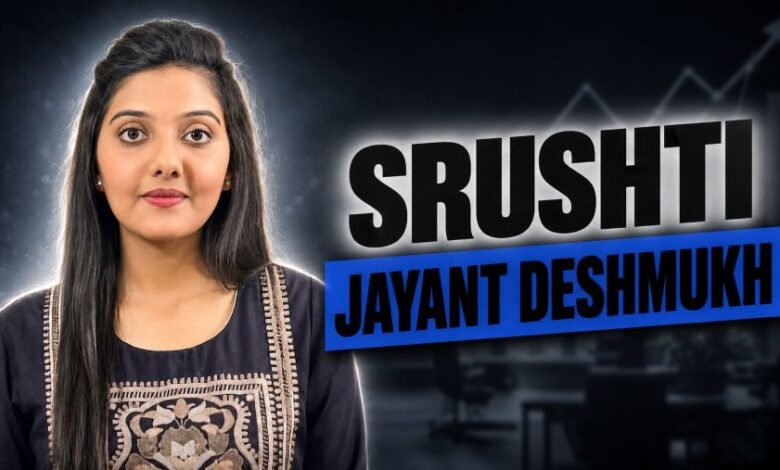
Srushti Jayant Deshmukh was 23 years old when the UPSC Civil Services Examination 2018 final result was announced on 5 April 2019. She secured All India Rank 5, became the highest-ranked woman candidate in that examination cycle and passed on her first attempt.
She later joined the Indian Administrative Service as a member of the 2019 batch and received the Madhya Pradesh cadre. As of July 2026, the Khandwa district administration lists her as an Additional Collector.
Her exact current age cannot be confirmed from a strong official birth record available publicly. Therefore, the most reliable age-related fact is that she was 23 when her UPSC final result was declared.
Srushti Jayant Deshmukh Quick Facts
| Detail | Verified information |
|---|---|
| Full name | Srushti Jayant Deshmukh |
| Professional name | Srushti Deshmukh Gowda |
| Profession | Indian Administrative Service officer |
| Age when UPSC result was announced | 23 years |
| Examination | UPSC Civil Services Examination 2018 |
| Final result date | 5 April 2019 |
| All India Rank | 5 |
| Position among women | Highest-ranked woman candidate |
| Number of attempts | First attempt |
| Degree | Bachelor of Engineering in Chemical Engineering |
| University | Rajiv Gandhi Proudyogiki Vishwavidyalaya, Bhopal |
| IAS batch | 2019 |
| IAS cadre | Madhya Pradesh |
| Current listed role | Additional Collector, Khandwa |
| Main reason for recognition | Securing AIR 5 in UPSC CSE 2018 |
How Old Was Srushti Jayant Deshmukh When She Cleared UPSC?
Srushti Jayant Deshmukh was 23 years old when she cleared the UPSC Civil Services Examination.
The examination is known as UPSC CSE 2018 because its main stages were connected with the 2018 examination cycle. However, the final result was announced on 5 April 2019.
This difference between the examination year and result year sometimes creates confusion.
The correct explanation is:
- She appeared in the UPSC Civil Services Examination 2018.
- The final result was announced in April 2019.
- She was 23 years old when the result was declared.
- She secured All India Rank 5.
- She passed on her first attempt.
The official Civil Services Examination 2018 result announcement confirmed her rank, educational background and position as the highest-ranked woman candidate.
What Is Srushti Jayant Deshmukh’s Current Age?
A reliable official public record confirming her complete date of birth is not available through the main government sources used for this article.
For that reason, it would not be responsible to calculate or publish her current age as a confirmed fact.
Many websites provide a birth date for her, but most do not support it with a government document, direct verified statement or another strong primary source.
The safely verified age statement is:
Srushti Jayant Deshmukh was 23 years old when the UPSC CSE 2018 final result was declared on 5 April 2019.
This answer directly satisfies the main search query without relying on an unverified birth date.
Who Is Srushti Jayant Deshmukh?
Srushti Jayant Deshmukh is an Indian Administrative Service officer from the Madhya Pradesh cadre.
She became nationally recognised after securing fifth position in one of India’s most competitive government recruitment examinations.
Her result received special attention because she:
- Finished among the top five candidates
- Became the highest-ranked woman candidate
- Passed at the age of 23
- Cleared the examination on her first attempt
- Prepared while completing an engineering degree
Her journey is often discussed alongside other professionals who entered public administration after studying a different subject. A related example is Pradeep Gawande, a medical doctor who later joined the IAS.
Education and Engineering Background
Srushti studied in Bhopal, Madhya Pradesh.
She completed a Bachelor of Engineering degree in Chemical Engineering from Rajiv Gandhi Proudyogiki Vishwavidyalaya in Bhopal.
Her engineering education was important because she prepared for the civil-services examination while continuing her university studies.
Managing both responsibilities required her to create a practical timetable. She did not wait until graduation to begin studying for UPSC.
Instead, she worked on the examination syllabus alongside her engineering subjects.
This early start gave her time to:
- Understand the large UPSC syllabus
- Build knowledge of current affairs
- Practise written answers
- Complete regular revision
- Take mock examinations
- Improve her time management
Her result showed that a candidate does not need to study political science or public administration at university to enter the civil services.
Students from engineering, medicine, commerce, science, arts and many other academic backgrounds can appear for the examination.
Her UPSC Examination Result
The Union Public Service Commission announced the Civil Services Examination 2018 final result on 5 April 2019.
Srushti secured All India Rank 5.
Kanishak Kataria secured the first overall position, while Srushti finished as the highest-ranked woman candidate.
A total of 759 candidates were recommended for appointment to different government services in that examination cycle.
Her high rank helped her receive an appointment to the Indian Administrative Service, commonly known as the IAS.
The IAS was her preferred service because it offered opportunities to work directly in administration and public development.
Did Srushti Deshmukh Clear UPSC on Her First Attempt?
Yes, she cleared the Civil Services Examination on her first attempt.
This achievement became a major part of her public story because the UPSC selection process is long and demanding.
Candidates must complete several stages:
Preliminary Examination
The preliminary stage contains objective questions. It is used to select candidates for the main written examination.
Main Examination
The main stage includes descriptive papers. Candidates must write detailed answers on subjects such as governance, history, society, economics, ethics and current affairs.
Personality Test
Candidates who pass the written stage attend an interview, officially called the Personality Test.
The final ranking is prepared using marks from the Main Examination and Personality Test.
Srushti successfully completed the entire process during her first examination cycle.
How Did She Prepare for UPSC?
Srushti has explained in public interviews that consistency was central to her preparation.
She reportedly studied for approximately five to six hours on regular days while also managing her engineering education.
Her preparation included:
- Reading newspapers
- Following current affairs
- Studying standard books
- Using selected online resources
- Practising answer writing
- Attempting mock tests
- Revising completed topics
She focused on studying regularly instead of following an extreme routine for only a few days.
This approach helped her maintain progress over a longer period.
She also reduced unnecessary social-media use during preparation. The decision allowed her to protect her study time and avoid distractions.
Why Consistency Mattered in Her Success
The UPSC syllabus covers a large number of subjects. It cannot normally be completed through last-minute study.
Srushti’s preparation method shows why a steady routine can be more useful than irregular long study sessions.
For example, studying for five focused hours every day can create better results than studying for fifteen hours once and then stopping for several days.
A consistent routine helps a candidate:
- Remember information for longer
- Complete the syllabus on time
- Identify weak subjects
- Practise more answers
- Reduce examination stress
- Build confidence gradually
Her experience does not provide one guaranteed formula for every student. Each candidate has different responsibilities, resources and learning needs.
However, her result offers a clear example of careful planning and regular work.
Her Optional Subject
Srushti selected Sociology as her optional subject for the UPSC Main Examination.
Her university subject was Chemical Engineering, but UPSC candidates are not required to choose an optional subject connected with their degree.
A candidate may select an optional subject after considering:
- Personal interest
- Understanding of the syllabus
- Availability of reliable study material
- Time needed for preparation
- Connection with general studies
- Comfort with writing detailed answers
Sociology covers society, institutions, social change, family structures and other topics connected with human communities.
It can also help candidates understand social issues discussed in General Studies and essay papers.
IAS Training and Madhya Pradesh Cadre
After her selection, Srushti joined the 2019 IAS batch.
She was allotted the Madhya Pradesh cadre.
New IAS officers complete formal training at the Lal Bahadur Shastri National Academy of Administration in Mussoorie.
The training introduces officers to areas such as:
- Indian law
- Public administration
- Government finance
- Economics
- Policy development
- District management
- Rural development
- Disaster response
- Leadership and communication
Trainee officers also complete field assignments to understand how government departments work at district and local levels.
Srushti later began serving in different administrative roles within Madhya Pradesh.
District Training in Dindori
Srushti completed district training in Dindori, Madhya Pradesh.
The district has a large tribal population and many rural communities.
Field training in such an area allows a young officer to understand practical challenges connected with:
- Education
- Healthcare
- Roads and transport
- Rural employment
- Public welfare
- Land administration
- Delivery of government schemes
District training is different from classroom learning because officers work directly with government employees and members of the public.
It gives them experience of how policies are implemented outside state and national capitals.
Work as Sub-Divisional Magistrate
Srushti later served as Sub-Divisional Magistrate in Gadarwara.
A Sub-Divisional Magistrate, also called an SDM, manages important administrative responsibilities within a subdivision of a district.
The work can include:
- Revenue administration
- Land-related cases
- Election duties
- Law-and-order coordination
- Public complaints
- Implementation of government orders
- Emergency response
This position gave her experience in handling administrative matters that directly affected local residents.
Rural Development Work in Burhanpur
She later served as Chief Executive Officer of the Zila Panchayat in Burhanpur.
A Zila Panchayat is an important part of rural local government at the district level.
Its work may cover:
- Village development
- Rural housing
- Employment schemes
- Sanitation
- Education
- Public health
- Roads and infrastructure
- Social-welfare programmes
The CEO works with different departments, local representatives and field employees to support rural development projects.
This role expanded her experience beyond revenue and subdivision administration.
What Is Srushti Deshmukh’s Current Position?
As of July 2026, the official Khandwa district administration lists Srushti Deshmukh Gowda as an Additional Collector in Khandwa, Madhya Pradesh.
An Additional Collector is a senior district officer who supports the Collector and other parts of the district administration.
The officer may be assigned work connected with:
- Revenue matters
- Government programmes
- Departmental coordination
- Administrative reviews
- Public complaints
- Election responsibilities
- Emergency management
The exact duties can vary according to government orders and the needs of the district.
Government postings may also change through official transfer orders. That is why the current-position information in this article is clearly dated.
Why Did Her Result Receive So Much Attention?
Srushti’s UPSC result became widely discussed because it combined several notable achievements.
She was young, still close to completing her engineering education and appearing for the examination for the first time.
She also became the highest-ranked woman candidate in the 2018 examination cycle.
Her interviews later became popular among students who wanted to understand:
- How she managed college and UPSC preparation
- How many hours she studied
- Which resources she used
- How she practised answer writing
- How she controlled distractions
- How she remained consistent
Her achievement also introduced many young readers to the wider work of Indian civil servants.
Readers can explore more profiles of notable Asian public figures whose work has attracted public attention.
What Can Students Learn From Her Journey?
Srushti’s experience provides several practical lessons for students preparing for difficult examinations.
Start preparation early
Beginning early gives a student more time to understand the syllabus and correct weak areas.
Build a realistic timetable
A timetable should match a person’s college, employment or family responsibilities.
An unrealistic schedule may work for a few days but can be difficult to maintain.
Limit study resources
Collecting too many books, videos and notes can create confusion.
A smaller number of reliable resources is often easier to revise.
Practise written answers
Knowing a topic is not enough for a descriptive examination.
Candidates must learn how to present their knowledge clearly within a fixed time and word limit.
Take mock tests seriously
Tests help candidates understand their speed, accuracy and level of preparation.
They also show which topics need more attention.
Revise regularly
Revision is necessary because the syllabus contains a large amount of information.
Without revision, a candidate may forget important facts before the examination.
Protect focused study time
Reducing unnecessary distractions can make daily preparation more productive.
Frequently Asked Questions
How old was Srushti Jayant Deshmukh when she cleared UPSC?
She was 23 years old when the UPSC Civil Services Examination 2018 final result was announced on 5 April 2019.
What is Srushti Jayant Deshmukh’s exact current age?
Her exact current age cannot be confirmed from a strong official birth record available publicly. The reliably reported fact is that she was 23 when the UPSC result was declared.
What was Srushti Deshmukh’s UPSC rank?
She secured All India Rank 5 in the Civil Services Examination 2018.
Was she the highest-ranked woman candidate?
Yes. She was the highest-ranked woman candidate in that examination cycle.
Did Srushti Deshmukh clear UPSC on her first attempt?
Yes. She passed the examination on her first attempt.
What did she study?
She completed a Bachelor of Engineering degree in Chemical Engineering.
Which university did she attend?
She studied at Rajiv Gandhi Proudyogiki Vishwavidyalaya in Bhopal.
What was her optional subject?
She selected Sociology as her optional subject for the Main Examination.
Which IAS batch does she belong to?
She belongs to the 2019 IAS batch.
Which cadre was she allotted?
She was allotted the Madhya Pradesh cadre.
What is Srushti Deshmukh’s current posting?
As of July 2026, the Khandwa district administration lists her as an Additional Collector.
Final Words
Srushti Jayant Deshmukh became widely known after securing All India Rank 5 in the UPSC Civil Services Examination 2018.
The most important answer for readers is simple: she was 23 years old when the final result was announced on 5 April 2019.
She was also the highest-ranked woman candidate and passed the examination on her first attempt while completing an engineering degree.
After joining the 2019 IAS batch, she received the Madhya Pradesh cadre and gained experience in district administration, subdivision management and rural development.
As of July 2026, she is officially listed as an Additional Collector in Khandwa.
Her journey shows that early preparation, regular answer writing, focused study and consistent revision can help a student work towards a demanding goal.