

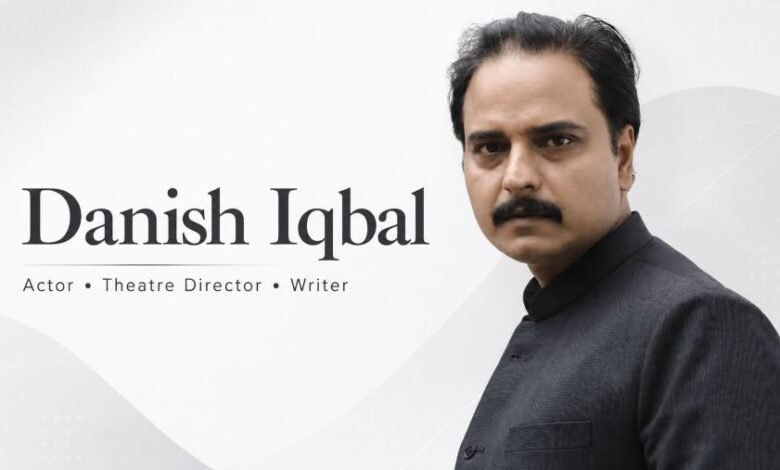
Danish Iqbal: From Allahabad Theatre to Dhurandhar Fame
Three decades on stage, years of acting education, and one secretive screen role that brought a veteran performer to a much bigger audience.

Last Updated on October 9, 2026 by Fame Katha Editorial Team
Introduction
Danish Iqbal did not arrive overnight.
Far from it.
Long before audiences knew him as Bade Sahab in Dhurandhar: The Revenge, he had spent decades acting on stage, studying theatre, directing productions, teaching performers, and taking screen roles that rarely turned him into a household name.
That changed rather suddenly.
His portrayal of Dawood Ibrahim, presented as Bade Sahab, in the 2026 film Dhurandhar: The Revenge brought Danish Iqbal a level of public attention that his long theatre career had never produced.
Yet calling him a new actor misses the point.
Actually, his professional theatre work dates back to 1994. He trained at the National School of Drama, studied classical acting in London, worked with the NSD Repertory Company, earned major theatre recognition, taught acting, and appeared in films and streaming series years before his 2026 breakthrough.
His story runs much deeper than one role.
Danish Iqbal Quick Facts
| Fact | Details |
|---|---|
| Full Name | Danish Iqbal |
| Alternate Credit | Danish Iqubal |
| Profession | Actor, theatre director, writer, acting teacher |
| Birthplace | Allahabad, Uttar Pradesh, India, now Prayagraj |
| Nationality | Indian |
| Theatre Career Started | 1994 |
| First Play | Ganga |
| Acting Mentor | Sachin Tiwari |
| Drama School | National School of Drama |
| NSD Graduation | 2002 |
| International Training | Royal Central School of Speech and Drama, London |
| Higher Study | MA in Classical Acting |
| Academic Qualification | PhD in theatre-related research |
| NSD Repertory Company | 2001–2007 |
| Major Award | Ustad Bismillah Khan Yuva Puraskar for Acting |
| Known TV/OTT Work | Aranyak, Maharani, Aakhri Sach, The Hunt |
| Known Films | A Mighty Heart, Bhakshak, Haq, Dhurandhar: The Revenge |
| Major 2026 Role | Dawood Ibrahim / Bade Sahab in Dhurandhar: The Revenge |
Danish Iqbal’s Early Life in Allahabad
Danish Iqbal was born in Allahabad, Uttar Pradesh, the city now officially called Prayagraj.
Performance was already close to home.
Iqbal has spoken publicly about his mother being involved in acting and theatre in Allahabad. She also taught theatre, giving him early contact with an art form that would later become his profession.
But acting was not his only dream.
He wanted to play cricket.
Iqbal has recalled playing for Allahabad and being selected from Uttar Pradesh for training connected with the Ranji Trophy pathway. That ambition did not become his profession.
Theatre did.
He started taking part in amateur theatre while still in school. In interviews, he has also credited Sachin Tiwari of Allahabad as his first acting teacher.
Those early years mattered.
No film sets yet. No fame.
Just performance, practice, and stage work.
His Theatre Career Started in 1994
Danish Iqbal has made one timeline particularly clear: his long career began with theatre, not Bollywood.
His first play was Ganga in 1994.
Official National School of Drama material also records 1994 as the start of his theatre career.
That distinction matters because online profiles sometimes describe him as having spent more than three decades in Bollywood.
That is inaccurate.
Iqbal himself has explained that the three-decade figure refers to his theatre career. His screen journey came later.
Basically, theatre came first.
And it stayed central.
National School of Drama Training
Iqbal eventually entered the National School of Drama in New Delhi, one of India’s best-known institutions for professional theatre training.
He graduated in 2002.
His connection with NSD went well beyond student life.
From 2001 until 2007, he worked with the NSD Repertory Company, giving him years of regular professional stage experience.
He performed.
He studied.
He kept working.
That period helped build the technical base behind the restrained, character-driven acting that later became visible in his film and streaming roles.
NSD records also connect him with teaching in subjects such as acting, voice, speech and diction.
He eventually returned to the institution as an invited teacher.
Studying Classical Acting in London
Danish Iqbal’s training did not stop in Delhi.
He received support through the Charles Wallace scholarship programme and travelled to Britain for further study.
He trained at London’s Central School of Speech and Drama, now known as the Royal Central School of Speech and Drama.
A professional record from 2010 states that he completed an MA in Classical Acting in 2005.
The move gave him exposure to another acting tradition.
Stage discipline was already familiar.
London added another layer.
Rather than abandoning his Indian theatre background, his career after returning home continued to move between performance, teaching, direction and screen work.
Danish Iqbal’s PhD and Academic Work
Iqbal also pursued formal academic research.
National School of Drama records state that he earned a PhD for research concerning the use of folk elements in Hindi stage presentations of Shakespeare’s plays.
His research title was:
“Shakespeare Ke Natakon Ki Hindi Manch Prastutiyon Mein Lok Tatvaon Ka Samavesh.”
That academic work fits naturally beside the rest of his career.
He was not working only as an actor.
He was studying performance itself.
He also spent years teaching acting, voice and stage technique.
Teaching Acting at Jamia Millia Islamia
Danish Iqbal became associated with the A.J.K. Mass Communication Research Centre at Jamia Millia Islamia in New Delhi.
Official Jamia material identifies Dr Danish Iqbal as a course coordinator connected with its PG Diploma in Acting.
His listed areas of expertise include theatre, acting, voice and speech.
Iqbal has said that after returning from England he spent around 13 years teaching acting in Delhi.
Teaching became a major part of his working life.
That is easy to miss now.
Current searches often lead straight to Dhurandhar, but his professional record had already crossed theatre performance, directing, writing, voice work and acting education.
More Than a Stage Actor
Theatre remained Iqbal’s main professional base for years.
An archived professional profile from 2010 reported that he had already acted in more than 100 plays by that point.
His listed stage work included productions connected with Shakespeare, Indian drama and contemporary theatre.
Among the titles linked with his acting career are:
- Twelfth Night
- Macbeth
- Othello
- Salome
- Devdas
- Seven Steps Around the Fire
- The Antigone Project
- Dancing with Dad
- Apne Dukh Mujhe Dedo
- Brain Child
His theatre work also took him outside India.
Records connect his performances with international festivals and productions in countries including Japan, Germany, France, Britain, Korea and Pakistan.
That meant years of stage work before wider screen recognition arrived.
A lot of work, quietly done.
Work With Major Theatre Practitioners
Iqbal’s professional theatre record also placed him around several respected directors, actors and theatre practitioners.
Older professional material connects his work with names including B. V. Karanth, Habib Tanvir, Anuradha Kapur, Roysten Abel, Mohan Agashe, Abhilash Pillai, Biju Viswanath, Naseeruddin Shah and Barry John.
These credits come from professional theatre records rather than complete production-by-production archives, so they are best understood as part of his documented working résumé.
Still, the pattern is clear.
His career was built inside serious theatre.
Danish Iqbal as a Theatre Director
Acting was only one part.
Iqbal also became a theatre director.
By 2010, his professional material credited him with directing more than 30 stage productions.
His directorial work has included titles such as:
- Daddy
- Saaransh
- Soul Saga
- Mahabhoj
- Ghasiram Kotwal
- An Inspector Calls
- A Midsummer Night’s Dream
- Macbeth
- Do Kaudi Ka Khel
- Qaid-e-Hayat
Some productions received clear institutional documentation.
In 2015, Jamia Millia Islamia reported that Iqbal directed and staged Mahesh Bhatt’s Daddy in Pakistan as part of a cultural exchange.
He later directed a student production of Romeo & Juliet at the National School of Drama in 2019.
So, yes, he acts.
But he also understands performance from the director’s chair.
Writing Work and Early Film Credits
Danish Iqbal has writing credits too.
Older professional records connect him with plays such as Khauff, Apne Paray, Ghalib Jo Na Badakhwar Hota and Confession.
Screen databases also credit him as a writer on:
- Grand Festival — 2006
- Kaash — 2007
- Sadho — 2019
His older credits are useful for another reason.
They confirm that Danish Iqubal is an alternate professional spelling used for Danish Iqbal.
So the spelling difference does not necessarily point to another actor.
Sadho and Independent Filmmaking
One of his notable independent projects is Sadho.
Iqbal worked on the film as a writer and director.
The project later received a Special Jury Award in the national section of the Kashmir World Film Festival.
That credit says a lot about his career.
He was not waiting only for acting calls.
He wrote.
He directed.
He built projects of his own.
Danish Iqbal and Radio Acting
Iqbal also spent time doing radio plays for All India Radio during his younger years.
He has said that his deep voice helped him receive voice assignments.
This was performance work rather than the long senior broadcasting career sometimes incorrectly attached to his name online.
There is an important reason for that confusion.
Another media professional named Danish Iqbal has also worked at Jamia Millia Islamia and All India Radio.
The two careers should not be mixed.
Two Danish Iqbals Are Often Confused Online
This is one of the biggest accuracy problems around Danish Iqbal’s online profile.
Dr Danish Iqbal, the actor, is the NSD-trained performer discussed here.
A different person, Prof Danish Iqbal, has a documented career as a broadcaster, playwright and academic connected with All India Radio.
Official Jamia records list them separately.
That matters.
Claims saying actor Danish Iqbal established FM Gold, headed major All India Radio departments or spent decades as a senior AIR broadcaster belong to the other professional.
The actor did perform in radio plays.
That part is documented.
The senior broadcasting career is not his.
This distinction keeps his story accurate.
Ustad Bismillah Khan Yuva Puraskar
Danish Iqbal’s theatre work earned national recognition.
He received the Ustad Bismillah Khan Yuva Puraskar for 2010 in the field of acting.
The award is given by the Sangeet Natak Akademi to younger artists who have made a strong mark in the performing arts.
Government of India records list Iqbal among the theatre recipients.
He has also received recognition from the National School of Drama through the Manohar Singh Smriti Puraskar for Direction.
NSD material further links his name with honours including the Mohan Rakesh Samman and a Nat Samrat Best Actor award.
Moving From Theatre to Screen
The transition to screen work happened gradually.
Very gradually.
Iqbal had already spent years in theatre when film and television roles began appearing.
One of his early internationally visible credits came in the 2007 film A Mighty Heart, starring Angelina Jolie.
He appears in the film as a male guest.
Iqbal later recalled working in a scene with Jolie and seeing the highly organised working method of an international film production.
More screen work followed.
But big recognition did not.
Not yet.
Aranyak Gave Him Wider Attention
A major change came with Netflix’s Aranyak.
Danish Iqbal played Govind Agarwal in the crime series.
He has spoken about the project as an important point in his screen career because it gave him a more substantial character during a period when he had spent years taking smaller film and television parts.
The series reached a broad streaming audience.
People started noticing him.
Then came more work.
Maharani and Dilshad Mirza
Iqbal’s appearance in Maharani gave him another recognisable screen character.
He played Dilshad Mirza.
The political drama already had a strong audience, and his role added another visible credit to a screen career that was beginning to gather more momentum.
By this stage, his background was unusual compared with many actors suddenly becoming known through streaming shows.
He already had decades behind him.
Aakhri Sach
In 2023, Danish Iqbal appeared in Aakhri Sach.
He played Aadesh, a member of the Rajawat family around which the investigation develops.
The crime drama gave him another serious character role and placed him alongside a cast led by Tamannaah Bhatia.
It continued a clear pattern.
Iqbal was increasingly being cast in restrained, authoritative or morally complex characters.
Bhakshak
In 2024, he appeared in Netflix’s Bhakshak.
His character was Suresh Singh.
The film starred Bhumi Pednekar and centred on a journalist investigating abuse at a shelter home.
For Iqbal, it was another screen credit inside a serious social drama rather than a conventional commercial star vehicle.
The Hunt: The Rajiv Gandhi Assassination Case
His streaming work continued in 2025.
Danish Iqbal appeared as Amod Kant in The Hunt: The Rajiv Gandhi Assassination Case.
The SonyLIV series dramatised the investigation following former Indian Prime Minister Rajiv Gandhi’s assassination.
The role placed Iqbal inside another fact-inspired crime and political drama.
By now, his face was becoming familiar.
His name still was not.
That would soon change.
Haq
Iqbal also appeared in the 2025 film Haq as Liaqat.
It became another entry in a busy run of screen work just before the project that pushed him into much wider public discussion.
Then came Bade Sahab.
Danish Iqbal as Bade Sahab in Dhurandhar: The Revenge
For many viewers, Danish Iqbal became Danish Iqbal in 2026.
His role in Dhurandhar: The Revenge changed public awareness around him almost immediately.
He portrayed Dawood Ibrahim, connected in the story with the mysterious figure known as Bade Sahab.
Before the reveal, speculation around Bade Sahab had become intense.
Several famous Bollywood names circulated in public discussion.
The actor was Danish Iqbal.
A theatre veteran.
That surprise worked in his favour.
Instead of audiences arriving with decades of screen-star baggage, many encountered him almost as a new face, even though his acting career was anything but new.
Even Danish Iqbal Did Not Know the Full Secret
Director Aditya Dhar kept the character tightly guarded.
Iqbal has said he knew he was playing Dawood Ibrahim but initially did not know the full connection between that character and Bade Sahab.
The secrecy continued through production.
Information was shared carefully.
His family knew he was part of the project, but he did not initially tell them the exact nature of the role.
That included his wife.
The secret held.
The Nine-Hour Prosthetic Process
Playing an older version of the character required extreme makeup sessions.
Iqbal has said the prosthetic work could take around eight to nine hours.
On some shoot days, he reported around 3 a.m. so the makeup team could prepare him before filming.
Several artists worked on the transformation.
Eating became difficult.
So did physical comfort.
The finished appearance changed his face enough to keep the casting surprise intact for many viewers.
For an actor built in theatre, where the performer often has to create character through body and voice with limited technical support, the experience was radically different.
Yet he made it work.
Why Dhurandhar Changed His Public Career
Dhurandhar: The Revenge did something earlier projects had not.
It connected Danish Iqbal’s face with his name on a mass scale.
After decades of stage acting and years of teaching, audiences started searching for him, reading about his training and discovering that Bade Sahab was far from his first serious role.
The attention came late.
But it came big.
His casting also worked because the audience did not fully know him already. He could disappear inside the character without viewers constantly seeing a famous star behind the performance.
That was a rare advantage.
Khosla Ka Ghosla 2
Iqbal’s next visible move took him somewhere quite different.
He joined Khosla Ka Ghosla 2, playing a character named Narula.
The film brought back actors associated with the original cult comedy, including Anupam Kher, Boman Irani, Ranvir Shorey, Parvin Dabas, Tara Sharma and Kiran Juneja.
It was released on August 28, 2026.
The shift was sharp.
After the dark intensity surrounding Bade Sahab, a comedy offered audiences another side of Danish Iqbal’s screen acting.
Danish Iqbal’s Selected Film and Series Credits
| Year | Project | Role / Work |
|---|---|---|
| 2006 | Grand Festival | Writer |
| 2007 | Kaash | Actor and writer |
| 2007 | A Mighty Heart | Male Guest |
| 2010 | 11 Weeks | Actor |
| 2019 | Sadho | Writer and director |
| 2020 | Chot | Villager |
| 2021 | Aranyak | Govind Agarwal |
| 2021–22 | Maharani | Dilshad Mirza |
| 2023 | Garmi | V. K. Singh / Vice Chancellor |
| 2023 | Aakhri Sach | Aadesh |
| 2023 | The Braid | Brahmin |
| 2024 | Bhakshak | Suresh Singh |
| 2025 | The Hunt: The Rajiv Gandhi Assassination Case | Amod Kant |
| 2025 | Haq | Liaqat |
| 2026 | Sankalp | K. C. Majumdar |
| 2026 | Dhurandhar: The Revenge | Dawood Ibrahim / Bade Sahab |
| 2026 | Khosla Ka Ghosla 2 | Narula |
A Career Built Before Fame
Danish Iqbal’s career makes more sense when viewed from the stage outward.
He did not spend decades chasing one breakthrough role.
He kept acting.
He kept teaching.
He wrote and directed.
He worked across theatre, radio, film and streaming productions, sometimes in roles that barely introduced him to mainstream viewers.
Then one character changed the scale.
That is the interesting part.
Bade Sahab did not create Danish Iqbal’s acting career. It exposed a much older one to an audience that had simply not been watching closely enough.
Final Thought
Danish Iqbal’s rise in 2026 looks sudden only from the outside.
His professional story started in Allahabad, moved through theatre in 1994, formal training at NSD, classical acting study in London, repertory work, teaching, direction, writing and years of smaller screen appearances.
Then the camera caught up.
Dhurandhar: The Revenge gave him mass recognition, but the skill behind the role had been built over decades.
That difference matters.
Danish Iqbal was never an overnight actor.
He was an overnight discovery.
FAQs
Who is Danish Iqbal?
Danish Iqbal is an Indian actor, theatre director, writer and acting teacher. He is trained at the National School of Drama and became widely known for playing Bade Sahab in Dhurandhar: The Revenge.
Where was Danish Iqbal born?
He was born in Allahabad, Uttar Pradesh, now officially called Prayagraj.
When did Danish Iqbal start acting?
His professional theatre career began in 1994 with the play Ganga.
Where did Danish Iqbal study acting?
He graduated from the National School of Drama in 2002 and later studied classical acting at the Central School of Speech and Drama in London.
What role did Danish Iqbal play in Dhurandhar: The Revenge?
He played Dawood Ibrahim, presented as Bade Sahab, in Dhurandhar: The Revenge.
Was Danish Iqbal in Maharani?
Yes. He played Dilshad Mirza in Maharani.
Was Danish Iqbal in Aranyak?
Yes. He appeared as Govind Agarwal in Netflix’s Aranyak.
Is Danish Iqbal also a theatre director?
Yes. He has directed numerous stage productions and has taught acting, voice and speech.