

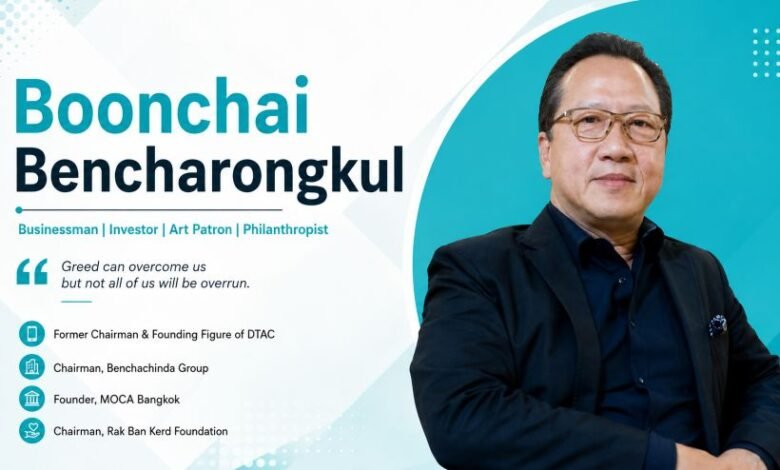
Boonchai Bencharongkul: The Man Behind DTAC and MOCA Bangkok
From Thailand’s mobile-phone boom to one of Bangkok’s major private art museums, Boonchai Bencharongkul has spent decades building businesses, collecting art, and putting part of his wealth into public-facing cultural and charitable work.

Last Updated on August 30, 2026 by Fame Katha Editorial Team
Introduction
Boonchai Bencharongkul has lived two very different professional lives.
First came telecom.
Then came art.
For decades, he was closely tied to the rise of mobile communications in Thailand. His name became associated with United Communication Industry, better known as UCOM, and Total Access Communication, or DTAC. He survived debt problems, the 1997 Asian financial crisis, changing ownership structures, and one of the biggest shifts in Thailand’s telecom sector.
Then his priorities changed.
Art moved forward.
Boonchai founded the Museum of Contemporary Art Bangkok, commonly called MOCA Bangkok, turning a large private collection into a museum open to the public. He also backed charity and rural-development work through the Ruam Duay Chuay Kan Sam Nuek Rak Ban Kerd Foundation.
His story is not simply about money. Actually, the more interesting part is how often his career changed direction.
As of July 8, 2026, Forbes estimated Boonchai Bencharongkul and his family at $915 million. That makes him one of Thailand’s wealthy business figures, though Forbes no longer places the family above the US$1 billion mark.
Quick Facts
| Fact | Details |
|---|---|
| Full Name | Boonchai Bencharongkul |
| Thai Name | บุญชัย เบญจรงคกุล |
| Date of Birth | June 25, 1954 |
| Age | 72, as of August 2026 |
| Nationality | Thai |
| Residence | Bangkok, Thailand |
| Profession | Businessman, investor, art collector and philanthropist |
| Known For | DTAC, UCOM, Benchachinda Group and MOCA Bangkok |
| Education | B.Sc. in Management, Northern Illinois University |
| Honorary Degree | Honorary Doctorate in Economic Science, Ramkhamhaeng University |
| Former Major Position | Chairman of DTAC |
| Current Business Connection | Benchachinda Holding |
| Benchachinda Holding Stake | 35.29%, based on a 2025 Thai SEC filing |
| Wife | Bongkot “Tak” Khongmalai |
| Children | Six, according to Forbes |
| Museum | Museum of Contemporary Art Bangkok |
| Estimated Net Worth | $915 million for Boonchai and family, Forbes estimate dated July 8, 2026 |
| Main Wealth Source | Investments |
| Major Charity Connection | Ruam Duay Chuay Kan Sam Nuek Rak Ban Kerd Foundation |
Boonchai Bencharongkul’s Early Life
Boonchai Bencharongkul was born on June 25, 1954.
He grew up inside a family already connected to Thailand’s communications business. His father, Suchin Bencharongkul, had built commercial ties with Motorola and worked in communications equipment.
That relationship mattered later.
A lot.
Forbes reported that Boonchai’s paternal grandfather, Kow Tee Sing, had migrated from Guangdong, China, to Bangkok. The family did not begin with the vast business interests later associated with the Bencharongkul name.
Suchin built much of that base.
Through commercial contacts and communications equipment work, he developed the business relationships his children would later inherit.
Boonchai has spoken positively about both parents. He credited his father with teaching him about work and personal relationships, while describing his mother, Kanchana, as a source of strength.
That family influence stayed with him.
Education in the United States
Boonchai spent part of his younger years in Illinois in the United States.
Forbes reported that he lived for a period with the family of Jim Searle, a Motorola executive connected with Southeast Asia.
He attended Harper College before moving to Northern Illinois University.
DTAC’s own corporate records identify his qualification as a Bachelor of Science in Management from Northern Illinois University.
Boonchai has also said in an interview that he studied Management and Economics while keeping an interest in art.
Art mattered early.
Business came first.
In fact, Boonchai has said he once wanted to become an artist. His parents had another direction in mind and sent him toward business studies.
That choice shaped decades of his life.
Years later, though, art returned in a very big way.
Returning to Thailand
Boonchai returned to Thailand in 1977 after his father asked him to come home.
He entered the family business.
His early work was not glamorous.
One assignment involved insurance.
Boonchai recalled receiving insurance training in Germany and later trying to sell hail and frost insurance to tobacco farmers. Convincing farmers to pay for protection against something that might never happen was tough.
Very tough.
He later described the assignment as a lesson in selling something people could not physically see.
His father’s thinking was simple: if Boonchai learned how to sell insurance, he could learn how to sell many other things.
The lesson stayed.
His Father’s Death Changed Everything
Suchin Bencharongkul died in 1981.
Boonchai was still young.
Suddenly, he faced far more responsibility.
The family businesses were not all healthy. There were debts, legal problems and weak operations that needed attention. Boonchai had to decide what could survive and what needed to go.
He shut or sold weaker operations and worked to find financing.
It was a hard period.
Boonchai later said one of the biggest things his father left behind was goodwill. People who had trusted and respected Suchin were willing to talk with his son.
That helped.
Money was one part of inheritance. Relationships were another.
Building UCOM
Boonchai became closely associated with United Communication Industry, commonly known as UCOM.
Older Forbes records date the company’s formation to around 1980. Motorola became an early investor.
The business focused increasingly on telecommunications.
DTAC corporate records show that Boonchai served as chairman of UCOM’s executive committee from 1984 to 1999.
Later, from 2002 to 2005, he served as UCOM’s CEO and president.
Phones were changing quickly during those years.
Boonchai saw an opening.
Mobile communication was still far from the everyday service it later became, but he believed demand in Thailand could grow.
That bet became central to his fortune.
Boonchai Bencharongkul and the Birth of DTAC
Total Access Communication was established in 1989.
The company eventually became widely known as DTAC.
Boonchai became chairman of its board on October 29, 1990, according to DTAC corporate records.
His connection lasted decades.
He also held operating roles inside the company. DTAC records list him as managing director from 2000 to 2001 and CEO from 2001 to 2002.
There is also a small story behind the company name.
Forbes reported that Boonchai said the “D” added to TAC was not originally meant to stand for “digital.” He viewed the letter as lucky.
Whatever its origin, DTAC became one of Thailand’s best-known mobile brands.
The 1997 Asian Financial Crisis
Success did not move in a straight line.
Then came 1997.
The Asian financial crisis hit Thailand hard, and telecom companies faced a particular problem. Their customers paid largely in Thai baht, while equipment purchases and financial commitments could involve foreign currencies.
When the baht fell, those foreign obligations became much harder to handle.
Boonchai’s business came under heavy pressure.
Forbes later reported that the crisis nearly ruined the company.
A major answer came from outside Thailand.
Norwegian telecommunications company Telenor entered the picture as a strategic partner.
Telenor brought capital and telecom experience. Its involvement grew over time, and the Norwegian company became deeply involved with UCOM and DTAC.
Boonchai had to give up some control.
But the business survived.
The Telenor Deal
The relationship with Telenor grew during the early 2000s.
By 2005, Boonchai and his siblings made a major sale.
Forbes reported in 2006 that the family sold its 40% stake in United Communication Industry to Telenor for about $225 million.
That was a major change in family ownership.
Still, Boonchai did not immediately walk away from DTAC.
He continued as chairman for years.
His connection with the telecom company eventually stretched across more than three decades.
Leaving DTAC After the True Merger
DTAC entered a new period in 2023.
The company merged with True Corporation.
Forbes describes the transaction as a deal valued at about $7.3 billion and reports that Boonchai divested his remaining DTAC interest following the merger.
His DTAC chapter ended after roughly 34 years.
That distinction matters.
Boonchai should now be described as a former chairman and founding figure associated with DTAC, rather than its current chairman.
After so much of his working life had been tied to telecommunications, the exit closed one of the longest chapters of his career.
Benchachinda Group and Current Business Interests
The Bencharongkul family still holds major business assets.
One important company is Benchachinda Holding.
Forbes describes the private company as active in areas including digital infrastructure and cybersecurity services.
A 2025 filing with Thailand’s Securities and Exchange Commission gives unusually clear ownership information.
According to that filing, Boonchai held 35.29% of Benchachinda Holding.
Vichai Bencharongkul held 37.23%, while other family members owned the remaining shares.
That makes Boonchai one of the company’s largest individual shareholders.
Recent public reporting has also identified him as chairman of Benchachinda Group.
Boonchai Bencharongkul’s Net Worth
Wealth estimates around Boonchai have changed a lot through the years.
Forbes estimated Boonchai Bencharongkul and his family at $915 million as of July 8, 2026.
The key wording is “and family.”
This is not an audited statement of cash sitting in Boonchai’s personal account. It is Forbes’ estimate of family wealth tied to investments and business interests.
His wealth has moved up and down over time.
Forbes valued him and his family above $1 billion during earlier periods. In 2015, for example, Forbes reported a figure of around $1.1 billion.
Later estimates moved lower.
Forbes listed the family at about $735 million in 2022 and $865 million in 2025 before raising the figure to $915 million in 2026.
So, right now, calling him a current US-dollar billionaire would be inaccurate based on the latest Forbes estimate.
From Telecom to Art
Business made Boonchai famous.
Art became personal.
His interest in art went back to his youth, long before he became known as a telecom executive.
He kept collecting.
Then the collection grew.
Eventually, keeping so much art inside private homes, offices or storage no longer made much sense to him.
He wanted people to see it.
That idea became MOCA Bangkok.
Founding MOCA Bangkok
The Museum of Contemporary Art Bangkok opened in 2012.
Boonchai founded the privately owned museum using his personal collection as its base.
MOCA Bangkok’s official information describes the museum as covering roughly 20,000 square metres and holding more than 1,000 works by Thai and international artists.
The museum pays close attention to Thai art.
Works connected with Buddhist ideas, Thai history, traditional imagery and contemporary artistic expression appear throughout the collection.
Boonchai also built a close relationship with major Thai artists.
One of the best-known names connected with the collection is Thawan Duchanee, an influential Thai artist whose work holds a major place inside MOCA.
For Boonchai, the museum became a way to move his collection from private ownership into public view.
How Much Did MOCA Cost?
Published figures differ.
Bangkok Post reported around the museum’s opening that Boonchai had invested approximately 2 billion baht in MOCA.
Forbes later reported roughly $30 million for land and construction, while also discussing substantial money spent collecting art.
Those figures do not appear to measure exactly the same costs.
So a fixed “total cost” would be misleading.
The safer fact is simple: Boonchai spent tens of millions of dollars across the museum, property and art collection.
His Son Kit and MOCA’s Next Chapter
Boonchai has also brought the next generation into the museum.
His son Kanachai “Kit” Bencharongkul has become closely involved with MOCA Bangkok.
The South China Morning Post reported in 2020 that Kit had been handling the museum’s day-to-day operations since 2018.
His work has included exhibitions, programming and efforts to connect the museum with newer audiences.
Boonchai remains the founder and collector behind MOCA.
But Kit now carries a large part of its day-to-day future.
Boonchai Bencharongkul’s Wife
Boonchai is married to Thai actress and filmmaker Bongkot “Tak” Khongmalai.
Their engagement attracted widespread attention in Thailand in 2012.
Bangkok Post reported that an engagement ceremony was planned for November 19, 2012, at MOCA Bangkok.
They married on March 28, 2013, at the Mandarin Oriental Hotel in Bangkok, according to The Nation.
The couple has a son together.
Public reports sometimes give conflicting counts for Boonchai’s earlier marriages and relationships. Because those accounts do not agree, an exact total should not be presented as settled fact.
Boonchai Bencharongkul’s Children
Forbes currently lists Boonchai as having six children.
Several children have appeared publicly in connection with his family interests.
Kanachai “Kit” Bencharongkul is well documented through his work with MOCA Bangkok.
Forbes has also identified Suprata and Boonyapa in earlier reporting connected with family charitable or cultural work.
A full six-name list is repeated on some websites, but strong independent sourcing for every name is inconsistent.
So the verified number is six.
That is the safer figure.
Philanthropy and Rak Ban Kerd
Boonchai has spent years supporting charity and rural development projects.
He is closely associated with the Ruam Duay Chuay Kan Sam Nuek Rak Ban Kerd Foundation.
DTAC’s 2020 corporate report listed him as chairman of the foundation from 1998 onward.
The Rak Ban Kerd work has focused on farmers, rural communities, agricultural education and sharing practical farming knowledge.
Some programmes have also supported education.
One philanthropic report described support for 999 young people through an early education programme.
The project later became more closely connected with agriculture, farmer recognition, local products and rural economic development.
Buddhism and Meditation
Buddhist practice has also been part of Boonchai’s public life.
Forbes has reported that he became increasingly interested in Buddhism after difficult periods, including his father’s death and the 1997 financial crisis.
He has also been associated with the Dhammakaya movement.
Forbes’ current profile says he meditates daily.
That spiritual interest fits with the way Boonchai talks about money and legacy.
He has repeatedly spoken about wealth as something that should eventually serve a purpose beyond personal consumption.
MOCA is probably the clearest example.
The 2016 Dhammakaya Dispute
Boonchai’s association with the Dhammakaya movement brought public criticism in 2016.
During a dispute involving authorities and Wat Phra Dhammakaya, Boonchai made comments encouraging followers to gather or practise Dhamma.
Critics argued that such comments could interfere with law-enforcement activity.
Bangkok Post reported that a former National Reform Council member accused him of possibly breaking Thai law. Thailand’s Department of Special Investigation later examined whether his comments could amount to encouraging an unlawful gathering.
DTAC publicly stated that Boonchai’s comments represented his personal position rather than the company’s view.
The available sources report an accusation and official examination of his comments.
They do not establish that Boonchai was convicted over the episode.
That difference should stay clear.
Royal Decorations and Honours
Boonchai has received several Thai royal decorations.
DTAC’s official corporate records list the following:
| Year | Honour |
|---|---|
| 1994 | Knight Grand Cross, First Class, Most Noble Order of the Crown of Thailand |
| 1997 | Knight Grand Cross, First Class, Order of the Direkgunabhorn |
| 2003 | Grand Cross, Third Class Higher Grade, Order of Chula Chom Klao |
| 2015 | Knight Grand Cordon, Special Class, Most Noble Order of the Crown of Thailand |
He also received an Honorary Doctorate in Economic Science from Ramkhamhaeng University.
Other Leadership Roles
DTAC’s corporate records document several positions beyond its own board.
Boonchai served as:
- Chairman of Benchachinda Holding
- Chairman of Private Property Co.
- Chairman of Ruam Duay Chuay Kan Sam Nuek Rak Ban Kerd Foundation
- Chairman of Hornbill Research Foundation from 2001 to 2006
- Director of United Distribution Business from 2002 to 2015
These roles show how far his interests spread beyond mobile communications.
Still, telecom remained the business most closely tied to his public name for many years.
Boonchai as an Author
Boonchai is also credited as the author of a book connected with his museum.
The title is Museum of Contemporary Art: MOCA Bangkok.
Google Books records the volume as published in 2012 by Thai Art Museum Company Limited.
The book runs to 327 pages.
Its publication came during the same year MOCA Bangkok opened.
What Boonchai Says About Business
Several ideas appear repeatedly in Boonchai’s interviews.
Work hard.
Keep good relationships.
And survive bad periods.
He has spoken about the value of honesty and diligence, lessons he connects with his parents.
He has also said that relationships can carry more lasting value than money.
That point makes sense within his own story.
After his father died, contacts built by Suchin helped the younger Boonchai during a difficult business period.
Later, during the financial crisis, Boonchai accepted outside help and shared control with Telenor rather than holding tightly to a structure that was under pressure.
Different situation.
Same instinct.
Keep the business alive.
How Boonchai Bencharongkul Built His Legacy
Boonchai’s career can be split into clear stages.
The first was survival.
He returned home, entered the family business and had to handle major responsibility after his father died.
The second was telecom growth.
UCOM and DTAC became major names, and mobile communication created huge wealth for the family.
Then came crisis.
The Asian financial crash forced difficult choices and brought Telenor much closer to the business.
Later came the exit.
The family sold a large UCOM stake, and Boonchai eventually left DTAC following its merger with True Corporation.
Art then took much more space in his public life.
MOCA Bangkok turned a personal passion into an institution that can continue beyond its founder.
That may end up being the part of his story that lasts longest.
Final Thought
Boonchai Bencharongkul spent decades close to some of the biggest changes in Thailand’s telecom business.
He made money there.
He nearly lost ground there too.
His career included family debt, mobile-phone expansion, a financial crisis, foreign investment, ownership changes and eventually an exit from DTAC after roughly 34 years.
But his story did not stop there.
He returned to the interest he had before business took over: art.
MOCA Bangkok now holds more than 1,000 works and gives the public access to a collection that could easily have remained private.
That shift says a lot.
Boonchai first built companies.
Later, he started thinking about what stays.
FAQs
Who is Boonchai Bencharongkul?
Boonchai Bencharongkul is a Thai businessman, investor, art collector and philanthropist. He is best known for his long association with DTAC, his interest in Benchachinda Group and for founding MOCA Bangkok.
How old is Boonchai Bencharongkul?
He was born on June 25, 1954. He is 72 years old as of August 2026.
What is Boonchai Bencharongkul’s net worth?
Forbes estimated Boonchai Bencharongkul and his family at $915 million as of July 8, 2026.
Is Boonchai Bencharongkul a billionaire?
Not under Forbes’ latest US-dollar estimate. Forbes currently values Boonchai and his family at $915 million. Earlier estimates had placed the family above $1 billion.
Who is Boonchai Bencharongkul’s wife?
He is married to Thai actress and filmmaker Bongkot “Tak” Khongmalai. They married on March 28, 2013.
How many children does Boonchai Bencharongkul have?
Forbes lists him as having six children.
Did Boonchai Bencharongkul found DTAC?
He was one of the major founding business figures behind Total Access Communication and became chairman of its board in 1990.
Is Boonchai still chairman of DTAC?
No. His DTAC connection ended after the company merged with True Corporation in 2023.
What is MOCA Bangkok?
MOCA Bangkok is a private contemporary-art museum founded by Boonchai. Its official site says the museum contains more than 1,000 Thai and international artworks.
What company does Boonchai Bencharongkul own now?
He remains a major shareholder in Benchachinda Holding. A 2025 Thai SEC filing recorded his stake at 35.29%.