
Zhang Yiming: The Quiet Engineer Who Built a Global Tech Empire
From writing software in China to building ByteDance, the company behind TikTok, his career shows how one idea changed the way millions of people watch videos and discover content.

Last Updated on October 9, 2026 by Fame Katha Editorial Team
Introduction
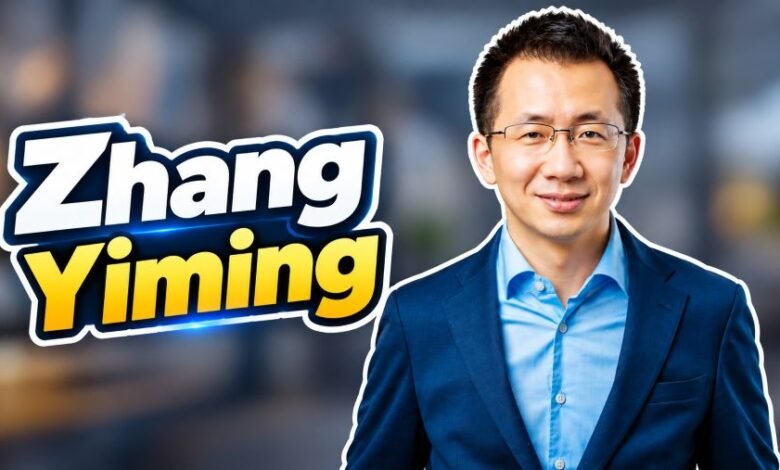
Zhang Yiming is a Chinese billionaire entrepreneur and the co-founder of ByteDance, the company behind TikTok, Douyin, and Toutiao. Born in April 1983, he started his career as a software engineer before building one of the world’s biggest private technology businesses.
His journey began in Fujian, China. He studied software engineering at Nankai University and worked for several internet companies.
Then came a bigger idea.
In 2012, he helped start ByteDance. Its content recommendation technology soon attracted millions of users. TikTok later brought the business worldwide.
He left the CEO position in 2021. Still, his ownership keeps him closely connected to the company.
As of September 2026, Bloomberg estimated his fortune at approximately $105 billion.
Quick Facts
| Detail | Information |
|---|---|
| Full Name | Zhang Yiming |
| Chinese Name | 张一鸣 |
| Birth | April 1983 |
| Age | 43 years old (2026) |
| Birthplace | Longyan, Fujian, China |
| Nationality | Chinese |
| Profession | Entrepreneur and software engineer |
| Education | Nankai University |
| Qualification | Bachelor’s degree in engineering |
| Famous For | Co-founding ByteDance |
| Company Founded | ByteDance, 2012 |
| Earlier Business | 99fang |
| Associated Platforms | TikTok, Douyin, Toutiao |
| Former Position | CEO and chairman of ByteDance |
| CEO Successor | Liang Rubo |
| Reported Residence | Singapore |
| Net Worth | Approximately $105 billion, Bloomberg estimate from September 2026 |
| Wealth Source | Ownership in ByteDance |
Early Life and Childhood
He was born in Longyan, Fujian Province. The city lies in southeastern China.
His childhood was far from Silicon Valley. Yet technology would define his future.
Accounts of his early life describe a family interested in education and new technology. His parents reportedly encouraged independent thinking.
He grew up during China’s economic expansion. Computers and internet services were becoming increasingly important.
Those changes opened new career opportunities.
However, detailed public records about his childhood remain limited. His professional life is much better documented.
Education and University Life
In 2001, he entered Nankai University in Tianjin.
He initially studied microelectronics. Later, he switched toward software engineering.
That change mattered.
He became interested in building practical software products. Programming offered a way to solve problems and test new ideas.
He graduated in 2005.
During his university years, he also met Liang Rubo, who later became his business partner and eventually took over ByteDance’s leadership.
The two would work together for years.
Their university connection later became part of one of China’s best-known business stories.
Starting His Career as an Engineer
Success did not arrive immediately.
After university, he joined Kuxun in 2006. It was a Chinese travel-search company.
He worked on software and search technology. Within a relatively short period, he took on greater technical responsibilities.
This gave him valuable experience.
He learned how internet products handled information. He also gained experience managing engineering work.
In 2008, he briefly joined Microsoft.
The position was different from startup life. He later moved to Fanfou, an early Chinese social networking service.
These jobs helped build his technical knowledge.
More importantly, they exposed him to online search, social platforms, and the challenges of building products for large audiences.
His First Business Venture
In 2009, he founded 99fang.
The business focused on online property searches. Users could find real-estate information through its service.
It was his first major independent venture.
Running the business offered a different experience. Instead of writing code for another company, he now had to handle product decisions and business growth.
But his interests were changing.
Smartphones were becoming more popular. Mobile internet use was growing quickly.
He began thinking about a service that could learn what people liked and present information without requiring them to search for everything themselves.
That idea would lead to ByteDance.
How ByteDance Started
In March 2012, he co-founded ByteDance with a team that included Liang Rubo.
The company began in a four-bedroom apartment in Beijing.
It was a modest beginning.
The founders saw a major opportunity in mobile internet services. They believed software could recommend information based on individual interests.
Traditional websites often depended on readers choosing categories or searching for specific topics.
ByteDance took another approach.
Its technology studied user behavior and recommended content that matched those interests.
In August 2012, the company launched Toutiao.
The news and information platform attracted users through personalized content recommendations.
According to ByteDance’s official company history, Toutiao was among its earliest major products.
That success gave the company room to grow.
Soon, short videos would become its biggest international opportunity.
The Story Behind TikTok
TikTok did not appear overnight.
ByteDance launched Douyin in China in September 2016. The short-video app allowed users to create and watch quick clips.
Its recommendation system helped people find videos based on their viewing habits.
The company introduced TikTok internationally in 2017.
Another major move followed.
In November 2017, ByteDance acquired Musical.ly, a popular short-video service founded by Alex Zhu and Luyu Yang.
The two platforms merged under the TikTok name in August 2018.
This brought together existing Musical.ly users and ByteDance’s technology.
Growth followed across many countries.
TikTok became especially popular for entertainment, music, comedy, education, and short creative videos.
For the company, it was a huge international success.
One detail deserves attention: the business was built through teamwork. Zhang founded ByteDance, but engineers, designers, product managers, and the Musical.ly founders also contributed to TikTok’s development.
Other Businesses Behind His Success
TikTok is the best-known ByteDance product. But the company operates several other services.
These include:
- Douyin: A short-video platform serving China.
- Toutiao: A personalized news and information application.
- CapCut: Video-editing software used by content creators.
- Lark and Feishu: Workplace communication and productivity services.
- Pico: Virtual-reality technology and devices.
- TikTok Shop: Shopping services connected with social content.
- Doubao: An artificial intelligence assistant.
- Seedance: AI technology for generating video.
Each business serves a different purpose.
Some focus on entertainment. Others support workplace tasks, shopping, or AI research.
Not every product was personally created by Zhang. These are businesses developed by ByteDance and its teams.
Why He Left the CEO Position
His decision surprised many people.
In May 2021, he announced plans to step down as ByteDance CEO.
At that time, the business was already widely known.
Liang Rubo was chosen as his successor.
In his letter to employees, he explained that his interests were better suited to long-term thinking than everyday management.
He preferred studying new ideas and technology.
Managing a huge company required different skills.
The leadership handover took place during 2021. He also stepped down as chairman later that year.
Still, leaving management did not mean losing every connection with ByteDance.
He remained a major shareholder.
Does He Still Own ByteDance?
Yes, he retains a substantial ownership interest.
Reuters reported in March 2024 that he held around 20% of ByteDance’s economic ownership and more than 50% of its voting rights.
These figures mean different things.
Economic ownership represents a financial interest in the company. Voting rights influence certain corporate decisions.
A person can hold less than half of a company’s shares while maintaining substantial voting power.
Still, shareholders do not necessarily manage everyday operations.
Liang Rubo succeeded him as CEO, and ByteDance’s official website identifies Liang as board chairman.
Net Worth and Billionaire Status in 2026
His wealth has increased sharply over the years.
Much of his fortune comes from ByteDance.
Unlike founders who hold large publicly traded share portfolios, his main wealth is tied to a private business.
This makes the exact value difficult to measure.
In September 2026, Bloomberg’s Billionaires Index estimated his net worth at approximately $105 billion, briefly placing him at the top of Asia’s wealth rankings.
Forbes offered a different figure.
Its real-time profile listed about $84 billion on September 16, 2026.
Why the difference?
The two publications use different valuation methods and assumptions about privately held assets.
Neither number represents his cash balance.
His fortune can also change when ByteDance’s estimated market value changes.
The main point is clear. His ownership of ByteDance has made him one of the world’s wealthiest technology entrepreneurs.
Personal Life and Family
He rarely discusses his private life.
Reports describe him as married. Some say he met his future wife while studying at Nankai University.
However, reliable public information about his spouse remains limited.
Details about his children and household are also not consistently confirmed by authoritative sources.
He has kept those matters largely separate from his professional career.
As for his interests, he has spoken publicly about reading, listening to music, spending time online, and thinking about future ideas.
Those interests appeared in his 2021 leadership letter.
Where Does He Live?
Forbes lists Singapore as his residence.
Reuters has also reported that Singapore became an important base for his work and travel.
However, living abroad does not automatically change someone’s citizenship.
Forbes continues to list his citizenship as Chinese.
He remains closely connected with ByteDance and China’s technology industry.
Philanthropy and Donations
His charitable work has received more attention in recent years.
In June 2021, he established the Fangmei Education Development Fund in his hometown region of Longyan.
He initially donated 500 million yuan.
The fund supported education and opportunities for young people.
In 2023, he contributed another 200 million yuan.
Then came another donation.
On July 21, 2026, the Longyan Municipal Education Bureau announced that he had given an extra 300 million yuan.
Of that amount, 200 million yuan was directed toward educational programs and school improvements. The remaining 100 million yuan supported healthcare services and medical facilities.
The fund also expanded its work beyond education and became the Fangmei Charitable Fund.
His total donations to that fund reached 1 billion yuan.
The details were published by the Longyan Municipal Education Bureau.
He also supported his former university.
In August 2024, he and Liang Rubo jointly donated 200 million yuan to Nankai University for mathematics research and student development.
These donations show his continuing interest in education and scientific research.
Awards and Public Recognition
His business achievements have brought international recognition.
In 2013, he appeared on the Forbes China 30 Under 30 list.
Fortune included him in its 40 Under 40 recognition in 2018.
A year later, TIME named him among its 100 Most Influential People of 2019.
His financial position also attracted attention.
In 2024, he topped the Hurun China Rich List. Bloomberg later ranked him as Asia’s richest person in September 2026.
Such wealth rankings can change quickly.
Still, these milestones show how far his career has come since his early engineering jobs.
Business Challenges and Controversies
Building a company this large brought difficulties.
ByteDance faced criticism and regulatory pressure in different countries.
In 2018, Chinese regulators shut down the company’s Neihan Duanzi entertainment app over content concerns.
Zhang publicly apologized for problems in managing content.
TikTok later faced international restrictions.
India banned the application in June 2020, citing national security and other concerns.
In the United States, lawmakers raised questions about user privacy, data security, and the company’s Chinese ownership.
ByteDance disputed parts of the criticism and challenged several government actions.
The company eventually changed its American business arrangements.
In January 2026, TikTok finalized a new U.S. joint-venture structure.
Under the agreement, American and global investors held 80.1% of the new venture, while ByteDance retained 19.9%.
Reuters reported that the arrangement involved investors including Oracle, Silver Lake, and MGX.
The deal allowed TikTok to continue operating in the United States under revised governance and security arrangements.
These were major corporate challenges. They should not be confused with proven personal wrongdoing by Zhang.
What Is He Doing Now?
As of October 2026, he has not returned as ByteDance CEO.
His public role remains relatively quiet.
Reports indicate that he has maintained an interest in the company’s long-term technology work, especially artificial intelligence.
ByteDance has invested in AI products such as Doubao and Seedance.
The company now competes in areas beyond social media.
His wealth also reflects investors’ expectations about those businesses.
But his exact daily responsibilities are not publicly detailed.
For now, his position is best described as ByteDance co-founder, substantial shareholder, and former chief executive.
Major Career Milestones
| Year | Event |
|---|---|
| 1983 | Born in Longyan, China |
| 2001 | Joined Nankai University |
| 2005 | Completed university studies |
| 2006 | Began working at Kuxun |
| 2008 | Worked at Microsoft and Fanfou |
| 2009 | Founded 99fang |
| 2012 | Co-founded ByteDance and launched Toutiao |
| 2016 | Douyin launched in China |
| 2017 | TikTok launched internationally |
| 2018 | Musical.ly merged with TikTok |
| 2019 | Named to the TIME 100 |
| 2021 | Stepped down as ByteDance CEO and chairman |
| 2024 | Made a joint university donation and topped the Hurun China Rich List |
| 2026 | Further charitable donation and major wealth milestone |
Final Thought
Zhang Yiming started as a software engineer.
He worked for small companies. He tried running his own business. Then he built ByteDance.
The company’s growth changed his career.
TikTok became a global name. ByteDance grew into a major private technology company. His ownership brought extraordinary wealth.
Yet his story has another side.
He stepped away from daily management while still relatively young. He has since kept a quieter public profile and supported education and healthcare projects.
His career shows what can happen when a technical idea finds a large audience.
And his story is still developing.
Frequently Asked Questions
1. Who is Zhang Yiming?
He is a Chinese billionaire entrepreneur who co-founded ByteDance, the company behind TikTok, Douyin, and Toutiao.
2. How old is he in 2026?
He is 43 years old. He was born in April 1983.
3. What is his educational background?
He studied at Nankai University in Tianjin and graduated in 2005 with an engineering degree.
4. Is he the founder of TikTok?
He co-founded ByteDance, which developed TikTok. The app’s growth also involved the Musical.ly acquisition and many development teams.
5. What is his net worth in 2026?
Bloomberg estimated his wealth at around $105 billion in September 2026. Forbes published a lower estimate of approximately $84 billion for the same period.
6. Who is his wife?
He is reported to be married, but reliable public information identifying his wife is limited.
7. Why did he leave ByteDance?
He said he preferred long-term strategy, technology, and research over the everyday responsibilities of running a large company.
8. Is he still the CEO?
No. He stepped down in 2021, and Liang Rubo succeeded him.
9. Where is he living?
Forbes lists Singapore as his residence. His citizenship remains Chinese.
10. Does he still have shares in ByteDance?
Yes. Reuters reported in 2024 that he retained a substantial ownership interest and more than half of the company’s voting rights.