

Nambi Narayanan: ISRO Career, Spy Case, Family and Fight for Justice
The Indian rocket scientist whose work in liquid propulsion was followed by a false espionage case and a legal battle that lasted decades.

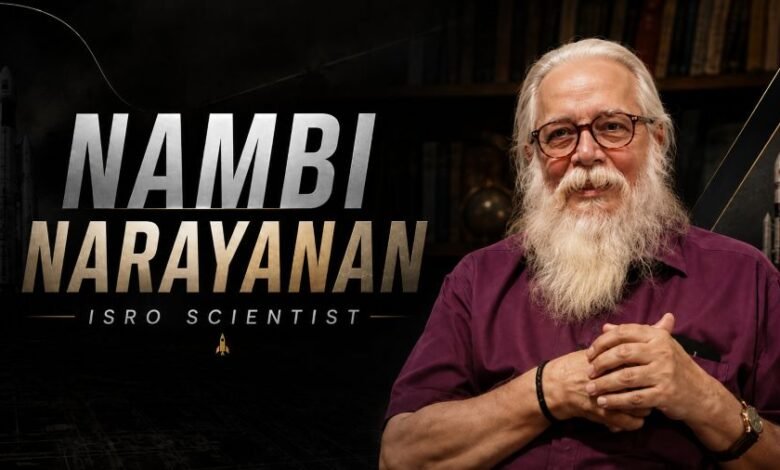
Last Updated on August 30, 2026 by Fame Katha Editorial Team
Introduction
For years, Nambi Narayanan’s name carried two very different stories.
One belonged to rockets.
The other belonged to a courtroom.
Before the 1994 ISRO espionage case turned his life upside down, Narayanan had already spent decades inside India’s space programme. He worked in liquid rocket propulsion, studied chemical rocket propulsion at Princeton University, joined an Indo-French engine programme, and later held senior positions at the Indian Space Research Organisation.
Then everything changed.
He was arrested. Accused of espionage. Publicly humiliated.
The accusations did not survive investigation. The Central Bureau of Investigation found the espionage case false. Years later, India’s Supreme Court recognised the damage caused to his liberty, dignity and reputation and awarded him compensation.
His story is often retold with exaggeration. Some accounts give him sole credit for technologies built by large ISRO teams. Other versions treat theories surrounding the spy case as established facts.
The documented story needs neither.
It is striking enough.
Nambi Narayanan Quick Facts
| Fact | Details |
|---|---|
| Full Name | Sankaralingam Nambi Narayanan |
| Known As | S. Nambi Narayanan |
| Date of Birth | 12 December 1941 |
| Birthplace | Nagercoil, present-day Kanyakumari district, Tamil Nadu, India |
| Nationality | Indian |
| Profession | Aerospace engineer and former ISRO scientist |
| Main Field | Liquid rocket propulsion |
| College | Thiagarajar College of Engineering, Madurai |
| Graduation | Mechanical Engineering, 1965 |
| Higher Education | Princeton University |
| Specialisation | Chemical rocket propulsion |
| Joined India’s Space Programme | 1966 |
| Major Work | Liquid propulsion and Viking/Vikas programme |
| Retired From ISRO | 2001 |
| Final ISRO Post | Director, Advanced Technology and Planning |
| Wife | Meena Narayanan |
| Children | One son and one daughter |
| Major Award | Padma Bhushan, 2019 |
| Famous Book | Ready to Fire: How India and I Survived the ISRO Spy Case |
| Biographical Film | Rocketry: The Nambi Effect |
Who Is Nambi Narayanan?
Nambi Narayanan is an Indian aerospace engineer best known for his work in India’s early liquid-propulsion programme and for surviving one of the country’s most widely discussed wrongful criminal investigations.
He joined India’s space programme in 1966.
That was early.
ISRO itself would formally come into existence in 1969. Indian rocket science was still building its basic technical base, and solid-propellant technology dominated much of the country’s early work.
Narayanan became interested in liquid propulsion.
That choice mattered.
Liquid-fuel engines offer control and performance characteristics that made them valuable for later launch vehicles. India needed people who could learn that technology, test it and make it work within the country’s growing space programme.
Narayanan became one of those engineers.
Early Life and Education
Sankaralingam Nambi Narayanan was born on 12 December 1941 in Nagercoil, in what was then Travancore.
Nagercoil now forms part of Tamil Nadu’s Kanyakumari district.
Details about his childhood vary across popular biography sites, so the safest account starts with what can be checked.
His engineering education is clear.
He studied mechanical engineering at Thiagarajar College of Engineering in Madurai. The college lists him among its notable alumni and identifies him with the 1965 Mechanical Engineering batch.
That training took him toward rockets.
Soon, his career changed direction.
Starting His Space Career in 1966
Narayanan joined India’s space effort in 1966 as a technical assistant.
At the time, the country’s space operation was small compared with the organisation people know today. Engineers were building knowledge from scratch, testing systems and learning from international scientific partnerships.
Narayanan initially worked around the early rocket programme.
But he saw promise elsewhere.
Liquid propulsion caught his attention.
His later career would become closely tied to it.
Princeton University and Chemical Rocket Propulsion
Narayanan went to the United States for advanced study at Princeton University.
There, he studied chemical rocket propulsion in the Department of Aerospace and Mechanical Sciences under aerospace scientist Luigi Crocco.
Then he came back.
That part is important.
India was still heavily dependent on solid-propellant technology. Narayanan returned with specialised knowledge in liquid propulsion at a time when that skill set was relatively rare inside the country’s young space programme. Published biographical material for his book confirms his Princeton training and his return to work in Indian rocketry.
Some online accounts say NASA formally offered him a job.
That claim is widely repeated, but a clear primary record confirming the exact employment offer is difficult to establish. For that reason, it should not be treated as a settled biographical fact.
What can be stated safely is simpler.
He studied in America.
Then he returned to India.
Nambi Narayanan and Liquid Propulsion
Back at India’s space programme, Narayanan pushed his work further into liquid rocket systems.
The technology was demanding.
Fuel had to flow correctly. Combustion had to remain controlled. Pumps, chambers, valves and other systems needed to work under extreme pressure.
There was little room for error.
India also needed outside technical cooperation during this stage.
That brought Narayanan into one of the best-known chapters of his scientific career.
The Viking and Vikas Connection
During the 1970s, India worked with France on liquid-propulsion technology linked to the French Viking engine.
Narayanan was part of this effort.
Published career records state that he led a group of Indian scientists sent to France as part of the programme that contributed to India’s development of the Vikas engine family.
Vikas later became closely associated with Indian launch vehicles.
But one point needs care.
Narayanan should not be described as the sole inventor of the Vikas engine.
ISRO projects are team efforts. Former colleagues have challenged versions of his life story that assign the engine mainly to one scientist.
A fair description is this:
Nambi Narayanan was one of the important engineers and team leaders involved in India’s liquid-propulsion work connected with the Viking-Vikas programme.
That claim fits the documented record without stripping credit from other engineers.
Senior Work at ISRO
His responsibilities grew over the years.
Published biographical material linked to Ready to Fire records him as serving in senior launch-vehicle and propulsion assignments, including work connected with rocket stages, the Liquid Propulsion Systems Centre and early cryogenic propulsion planning.
He later served as Director, Advanced Technology and Planning at ISRO.
He retired in 2001.
That gave him roughly three and a half decades inside India’s space effort.
Quite a run.
Yet his scientific career is now inseparable from what happened in 1994.
The 1994 ISRO Espionage Case
The case began far away from rocket engineering.
In October 1994, Kerala Police registered a case involving Mariam Rasheeda, a Maldivian national, initially over immigration-related issues.
The investigation then changed direction.
Police claimed that secret information connected with India’s space programme had been passed through a network involving Maldivian nationals, scientists and others.
Narayanan became one of the accused.
He was arrested on 30 November 1994.
The accusation was grave.
He was suspected of passing sensitive information linked to ISRO technology.
His public standing collapsed almost overnight.
But the case had a problem.
The evidence did not hold.
What the CBI Found
The investigation was transferred to the Central Bureau of Investigation.
The agency examined documents, technical records, supposed financial links and the core espionage allegations.
Its findings broke the prosecution story apart.
The Supreme Court later recorded that the espionage allegations were found false.
One section of the investigation dealt directly with drawings and documents that Narayanan was accused of passing to others.
Investigators found that although he was a senior scientist with access to technical material, the particular drawings central to the accusation had not been issued to him.
A scientific committee also examined whether relevant documents were missing.
They were not.
The Supreme Court record states that the allegation that Narayanan and another scientist had passed those documents to a third party was found false.
That was a major break.
The spy story was falling apart.
Discharged From the Case
The CBI submitted its findings before the court.
In 1996, the accused were discharged after the CBI concluded that the espionage allegations could not be sustained.
Kerala later tried to reopen the investigation.
That attempt reached the Supreme Court.
In 1998, the Court stopped the fresh investigation.
Narayanan had cleared the criminal accusation.
His fight was far from finished.
A Battle for Accountability
Being cleared did not restore the years he had lost.
It did not erase the arrest.
It did not repair his public reputation overnight.
So Narayanan kept fighting.
His legal battle shifted from proving his innocence to seeking compensation and accountability for what had happened.
Years passed.
Then came a major judgment.
Supreme Court Judgment of 2018
On 14 September 2018, the Supreme Court delivered its judgment in S. Nambi Narayanan v. Siby Mathews and Others.
The Court recognised the severe harm caused by the case.
It referred to his wrongful imprisonment, malicious prosecution, humiliation and defamation. It also found that his liberty and dignity had been damaged.
The Court ordered the Kerala government to pay him ₹50 lakh in compensation.
The ruling went beyond money.
A committee headed by former Supreme Court judge Justice D. K. Jain was set up to examine the conduct of officials linked with the investigation.
For Narayanan, the question had changed.
Who was responsible?
Later CBI Case Against Former Officials
The accountability issue continued into the next decade.
The CBI opened a fresh case in 2021 following Supreme Court proceedings concerning the alleged framing of Narayanan.
In 2024, the agency filed a chargesheet against five former officials.
The CBI alleged that the original espionage case had been fabricated and that people caught in it were subjected to unlawful treatment.
The chargesheet included allegations involving criminal conspiracy, wrongful confinement, fabrication of evidence and physical abuse.
These allegations need correct wording.
A chargesheet is not a conviction.
The former officials accused in the later case are entitled to the legal process, and claims against them should be described as CBI allegations unless decided by a court.
Compensation Paid to Nambi Narayanan
Narayanan received compensation through more than one legal route.
The Supreme Court awarded him ₹50 lakh in 2018.
Earlier proceedings had also led to ₹10 lakh in relief linked to the National Human Rights Commission.
In 2020, the Kerala government agreed to pay ₹1.30 crore to settle his separate damages claim.
Reports commonly place the combined amount from these three parts at around ₹1.90 crore.
The money could acknowledge the wrong.
It could not erase it.
Did the Spy Case Delay India’s Cryogenic Programme?
Narayanan has argued that the espionage case hurt India’s cryogenic rocket programme and delayed progress.
That view has received wide coverage.
Still, it is disputed.
Several former ISRO scientists have challenged claims that the case delayed India’s cryogenic development by a fixed period such as 14 or 15 years.
So the stronger wording is simple:
Narayanan believes the false case damaged India’s cryogenic work, while some former ISRO colleagues disagree with the scale of that effect.
There is no need to turn a disputed estimate into fact.
Was There a CIA Conspiracy?
Narayanan has publicly raised questions about possible foreign involvement in the events surrounding the case.
Claims involving the CIA have appeared in books, interviews and public discussion.
But they remain claims.
No court judgment has established that the CIA framed Narayanan.
That distinction matters.
A reliable Nambi Narayanan biography should say that he suspected or alleged foreign involvement, rather than claiming such involvement was legally proven.
Nambi Narayanan’s Wife and Family
Narayanan is married to Meena Narayanan.
Published biographical material confirms that the couple have one son and one daughter.
His daughter, Geetha Arunan, has worked in education.
She is married to ISRO scientist Subbiah Arunan, who became closely associated with India’s Mars Orbiter Mission.
Narayanan has also spoken publicly about how the espionage accusation affected his family.
The case was not confined to police stations and courtrooms.
It followed them home.
Social suspicion became part of daily life.
That personal cost became one of the recurring themes in Narayanan’s later interviews and writing.
Nambi Narayanan’s Books
Narayanan has helped document his own story through books.
Ormakalude Bhramanapadham
His Malayalam autobiography, Ormakalude Bhramanapadham, was published in 2017.
The book recounts his scientific career and the espionage case from his own perspective.
Ready to Fire
In 2018, Narayanan and journalist Arun Ram published:
Ready to Fire: How India and I Survived the ISRO Spy Case
The book covers his ISRO career, propulsion work, arrest and long legal fight.
It is useful.
But it is also his account.
Claims in any autobiography still need outside checking when independent evidence exists or when former colleagues give a different version.
Rocketry: The Nambi Effect
A much wider audience learned about Narayanan through the film Rocketry: The Nambi Effect, released in 2022.
Actor R. Madhavan portrayed Narayanan and directed the film.
The movie follows Narayanan’s scientific career, personal life and the espionage case.
It drew fresh public attention to his story.
But the film should not be treated as a documentary.
Some former ISRO scientists challenged parts of its portrayal of Narayanan’s technical contributions and certain events.
That does not change his exoneration.
The legal record stands independently.
It simply means the cinema version and the historical record should not be treated as identical.
Padma Bhushan
In 2019, the Government of India awarded Nambi Narayanan the Padma Bhushan in the field of Science and Engineering.
The official Padma list records his full name as Sankaralingam Nambi Narayanan and lists Kerala alongside the award entry.
It was one of the biggest public honours of his later life.
By then, his name had changed meaning in public discussion.
He was no longer remembered mainly as an accused scientist.
He was a decorated former ISRO engineer whose prosecution had been found baseless.
What Is Nambi Narayanan Known For?
Several parts of his life stand out.
His liquid-propulsion work came first.
His role in the Viking-Vikas programme is part of India’s early rocket-engine history.
His false implication in the ISRO espionage case brought a very different kind of attention.
Then came the legal fight.
For decades, he pushed for his name to be cleared and for the actions surrounding the investigation to be examined.
That fight became as famous as his engineering career.
Nambi Narayanan’s Legacy
Narayanan’s legacy needs balance.
He was not the only person behind India’s liquid engines. Large scientific programmes rarely belong to one engineer.
Still, his contribution was real.
He worked during the formative years of India’s space effort, trained in liquid rocket propulsion, took part in the Indo-French propulsion programme and spent decades inside ISRO.
Then came an accusation that collapsed.
The Supreme Court record leaves little doubt about the damage he suffered through the false prosecution. His case became an example of what can happen when investigative power is used without a sound factual base.
Science made his career.
The law reshaped his life.
Both belong in the story.
Final Thought
Nambi Narayanan’s biography is sometimes written like a movie script.
It does not need that treatment.
The checked facts already carry weight.
He was born in 1941, trained as an engineer, studied rocket propulsion at Princeton, joined India’s space programme in 1966 and spent decades working on propulsion systems.
Then police accused him of espionage.
The case failed.
The CBI found the allegations false. The Supreme Court later recognised his wrongful imprisonment, humiliation and malicious prosecution and awarded compensation.
That is the real story.
Sharp. Difficult. Documented.
His scientific record deserves careful credit, shared where team credit belongs. His exoneration deserves equally clear language.
No myth is needed.
FAQs
Who is Nambi Narayanan?
Nambi Narayanan is a former ISRO scientist and aerospace engineer known for his work in liquid rocket propulsion and for being falsely implicated in the 1994 ISRO espionage case.
When was Nambi Narayanan born?
He was born on 12 December 1941 in Nagercoil.
What did Nambi Narayanan do at ISRO?
He worked mainly in rocket propulsion, including liquid-propulsion programmes and senior launch-vehicle assignments. He was involved in the Indo-French work connected with the Viking-Vikas engine programme.
Did Nambi Narayanan invent the Vikas engine?
It is inaccurate to credit the Vikas engine to one scientist alone. Narayanan was an important participant and team leader in the programme, which involved many Indian and French engineers.
Was Nambi Narayanan guilty of spying?
No. The CBI found the espionage allegations false, and the accused were discharged. The Supreme Court later recognised the wrongful treatment Narayanan suffered.
When was Nambi Narayanan arrested?
He was arrested on 30 November 1994 during the ISRO espionage investigation.
How much compensation did Nambi Narayanan receive?
He received compensation through several proceedings, including ₹50 lakh ordered by the Supreme Court in 2018 and a later ₹1.30 crore settlement from the Kerala government.
Which award did Nambi Narayanan receive?
He received the Padma Bhushan in 2019 for Science and Engineering.
Who is Nambi Narayanan’s wife?
His wife is Meena Narayanan.
Is Rocketry: The Nambi Effect a true story?
The film is based on Narayanan’s life and the ISRO espionage case. Some former ISRO scientists have disputed parts of its portrayal of his technical career, so it should not be treated as a documentary record.