
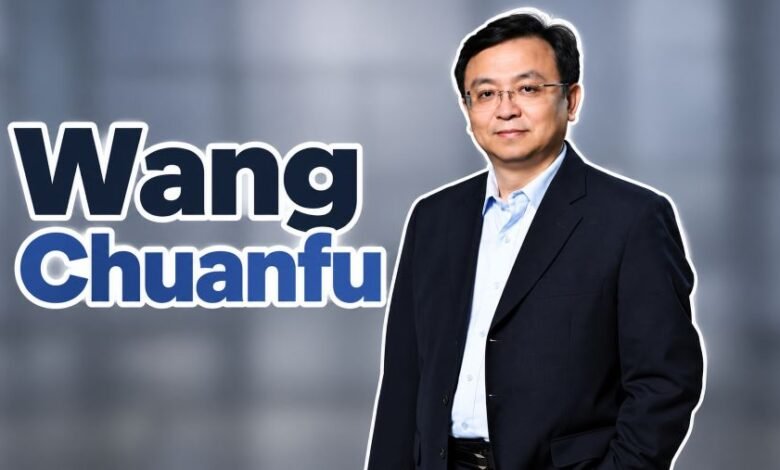
Wang Chuanfu: The Engineer Who Turned a Small Battery Business Into BYD
From a poor farming family in China to leading one of the world's biggest electric car companies, his story is built on years of engineering work and some very bold business decisions.

Last Updated on October 14, 2026 by Fame Katha Editorial Team
Introduction
Wang Chuanfu is a Chinese billionaire, engineer, and the founder of BYD, a major manufacturer of electric cars and batteries. He started the business in 1995. Today, BYD sells vehicles across international markets and competes with some of the biggest names in the car industry.
His journey began very differently.
He grew up in a farming family, lost both parents while young, and relied on his older siblings to stay in school. Years later, he used his knowledge of battery technology to build a company that would enter the global automotive market.
He remains BYD’s chairman and president in 2026. His work has earned international recognition, including a place on TIME’s list of the 100 most influential people in 2024.
Quick Facts
| Detail | Information |
|---|---|
| Full Name | Wang Chuanfu |
| Chinese Name | 王传福 |
| Birth | February 1966 |
| Age | 60 years (2026) |
| Birthplace | Wuwei, Anhui, China |
| Nationality | Chinese |
| Profession | Engineer, entrepreneur, business executive |
| Famous For | Founding BYD |
| Company | BYD Company Limited |
| Business Started | February 1995 |
| Current Position | Chairman and President of BYD |
| Education | Central South University of Technology |
| Higher Education | Beijing Nonferrous Metals Research Institute |
| Qualification | Master’s degree |
| Elder Brother | Wang Chuanfang |
| Cousin and Co-founder | Lu Xiangyang |
| Marital Status | Married |
| Residence | Shenzhen, China |
| Wealth Source | Batteries and automobiles |
| Net Worth | Approximately $20.8 billion, Forbes estimate dated September 11, 2026 |
Early Life and Childhood
Wang was born in February 1966 in Wuwei, Anhui Province, China.
His family had little money.
He grew up in a rural household where farming supported everyday life. His parents worked hard, but the family faced serious financial problems.
Then his childhood took a difficult turn.
Both parents died while he was still young. His elder brother and sister helped raise him, and the family worked to keep him in education.
His elder brother, Wang Chuanfang, became especially important during these years.
According to accounts from Central South University’s academic community, his brother helped pay for his studies and everyday expenses. When Wang moved to Changsha for university, his brother followed and ran a small business to support him.
That support mattered.
Wang could continue studying instead of leaving school to earn money. His education later gave him the technical knowledge needed for his business career.
Education and University Years
He took his studies seriously.
In 1983, Wang entered Central South University of Technology in Changsha, now part of Central South University.
He studied metallurgical physical chemistry.
The subject covers how metals and other materials behave during chemical and industrial processes. It requires a strong understanding of chemistry and engineering.
He completed his bachelor’s degree in 1987.
But he wanted to learn more.
Wang continued at the Beijing General Research Institute for Nonferrous Metals, where he studied for a master’s degree.
He graduated in 1990.
This period introduced him to advanced materials research and battery technology. Those subjects would later become central to his work at BYD.
His academic qualifications are confirmed by BYD’s official executive biography.
His First Job and Battery Research
Wang did not start as a carmaker.
After finishing his postgraduate studies, he worked at the Beijing General Research Institute for Nonferrous Metals.
His work involved research and engineering. He later held a deputy-director position at the institute.
In 1993, he became general manager of Shenzhen Beagle Battery Co., Ltd.
This job gave him practical business experience.
He was no longer dealing only with research. He could now see how batteries were made, how factories operated, and how manufacturers worked with customers.
At that time, portable electronic devices were becoming more common. Rechargeable batteries had growing commercial demand.
Wang saw an opportunity.
He believed a Chinese company could produce competitive rechargeable batteries without depending on the same expensive manufacturing systems used by established overseas producers.
That idea became his starting point.
How He Founded BYD
In February 1995, Wang established Shenzhen BYD Industrial Co., Ltd.
He was 29 years old.
The company started with around 20 employees and approximately 2.5 million yuan in capital, according to BYD’s published company history.
His cousin Lu Xiangyang helped finance and establish the business.
The first products were rechargeable batteries, including nickel-cadmium batteries used in electronic equipment.
Money was tight.
Rather than buy every costly machine available on the market, Wang developed a production approach that combined equipment with carefully organised manual work.
This helped the young company manage its costs.
BYD later moved into other battery types, including lithium-ion batteries.
The business grew as mobile phones became widely used. It began supplying major electronics companies, including Motorola and Nokia.
By 2002, BYD had gained enough scale to list on the Hong Kong Stock Exchange.
It was a major change.
A small manufacturer had become a public company. But Wang was already thinking about another industry.
Entering the Automobile Industry
In 2003, BYD acquired Xi’an Qinchuan Automobile.
This brought the company into vehicle manufacturing.
The decision carried real risk. Making batteries was one business. Building complete cars required new factories, engineering systems, suppliers, and customer support.
Still, Wang believed battery knowledge could help BYD compete as cars became more dependent on electrical technology.
In 2005, BYD launched the F3 sedan.
The model helped establish the brand in China’s passenger car market.
Then came a bigger technical move.
In 2008, BYD introduced the F3DM, an early mass-produced plug-in hybrid car. It could use electric power alongside a petrol engine.
The same year brought another important development.
Berkshire Hathaway, the investment group associated with Warren Buffett and Charlie Munger, acquired a roughly 10% stake in BYD for approximately $230 million.
That investment brought international attention to the Chinese manufacturer.
Berkshire Hathaway eventually sold its entire holding in 2025, after many years as an investor.
Building BYD Into an Electric Car Company
Wang continued putting money into battery research and electric transport.
The company developed electric buses, passenger cars, battery systems, and other technologies.
One major step came in 2020.
BYD introduced its Blade Battery, which uses lithium iron phosphate chemistry and a cell arrangement intended to make better use of battery-pack space.
Battery safety and cost became major selling points.
In March 2022, BYD stopped manufacturing new petrol-only vehicles. It decided to concentrate on battery-electric vehicles and plug-in hybrids.
This was a clear business decision.
The company could direct more of its manufacturing and research work towards vehicles that use electric power.
BYD’s business now covers automobiles, batteries, energy systems, electronics, and rail transport.
In 2025, it reported approximately 4.6 million new-energy vehicle sales. That figure includes battery-electric vehicles and plug-in hybrids.
The company also reported revenue of around 804 billion yuan.
Those numbers show how far the business has grown since its early battery-manufacturing years.
Business Strategy and Leadership Style
Wang has an engineering background, and that shows in the way he manages BYD.
The company makes many of its own major components.
These include batteries, electric motors, and several electronic systems used in its vehicles.
That gives BYD direct control over substantial parts of production.
It can help reduce dependence on outside manufacturers and make costs easier to manage, though it also requires significant spending on factories and research.
Wang has kept this approach for years.
His leadership attracted attention outside China. In 2024, former Volkswagen CEO Herbert Diess wrote about him for TIME’s 100 Most Influential People list.
Diess pointed to Wang’s early belief in electric vehicles, his attention to cost management, and his willingness to stay with long-term plans.
The industry has changed a lot since BYD started.
Still, its battery expertise remains one of the main reasons the company can compete in electric transport.
Major Career Achievements
Wang’s career includes several important business and personal milestones.
| Year | Achievement |
|---|---|
| 1987 | Completed bachelor’s degree |
| 1990 | Earned master’s degree |
| 1993 | Became a battery-company general manager |
| 1995 | Co-founded BYD |
| 2002 | BYD listed in Hong Kong |
| 2003 | Entered automobile manufacturing |
| 2005 | Introduced the F3 sedan |
| 2008 | Launched F3DM and gained Berkshire Hathaway investment |
| 2011 | BYD listed on the Shenzhen Stock Exchange |
| 2014 | Received the Zayed Future Energy Prize Lifetime Achievement Award |
| 2020 | BYD introduced Blade Battery technology |
| 2022 | Stopped petrol-only vehicle manufacturing |
| 2024 | Named among TIME’s 100 Most Influential People |
| 2025 | BYD sold around 4.6 million new-energy vehicles |
| 2026 | Re-elected chairman and reappointed president of BYD |
His awards have recognised work in battery technology, manufacturing, and energy-related industries.
The 2014 Zayed Future Energy Prize was particularly notable. The award recognised his career contributions to batteries and energy technology.
In 2024, TIME also included him in its TIME100 Climate list.
Net Worth and Source of Wealth
Wang is one of China’s best-known billionaire entrepreneurs.
His wealth comes mainly from BYD shares.
According to Forbes’ billionaire profile, his estimated net worth was approximately $20.8 billion as of September 11, 2026.
This figure can change.
Share prices move daily, so billionaire wealth estimates are not fixed amounts of money sitting in a bank account.
His fortune has grown from his ownership interests in the company he helped establish.
BYD’s September 2026 corporate filing identifies him as a major shareholder and controlling figure in the business.
His financial success is closely connected to the company’s long-term performance.
Family, Marriage and Personal Life
Wang keeps much of his private life away from public attention.
He is married.
Forbes lists his residence as Shenzhen, China, where BYD is headquartered.
His elder brother, Wang Chuanfang, helped support his education during difficult years. His cousin Lu Xiangyang later worked with him in establishing BYD.
These family relationships are documented in reliable published accounts and corporate records.
A Fortune profile published in 2009 also reported that Wang had two children. More recent personal details have not been reliably established.
His wife’s name and other private family information are not included here because they could not be confirmed from reliable sources.
Wang is better known publicly for his engineering work and business decisions than for discussing family life.
Challenges and Difficult Decisions
Building a large car company has brought problems too.
Competition in China has become intense.
Manufacturers frequently compete on vehicle prices, technology, and sales offers. Lower prices can attract customers, but they can also reduce profit margins.
BYD has faced that pressure.
In 2025, its net profit fell by about 19% from the previous year, according to Reuters, even as the company reported higher annual revenue.
International expansion has brought another set of problems.
Tariffs, trade rules, and political concerns can make it harder to sell Chinese-made vehicles in some countries.
BYD has also faced scrutiny over labour conditions involving contractors at its factory project in Brazil. Brazilian authorities reported serious violations involving contractor-employed workers, and legal proceedings followed. BYD ended its relationship with the implicated construction contractor.
These matters concern the company’s operations and should not be confused with established personal wrongdoing by Wang.
The pressure is real.
He now has to manage a much larger business while competitors work to win the same customers.
What Is He Doing in 2026?
Wang continues to lead BYD.
On September 29, 2026, the company’s ninth board of directors elected him chairman for another three-year term and appointed him president.
His responsibilities cover company operations and business strategy.
BYD is working to sell more vehicles outside China while continuing its research into batteries, charging systems, and electric transport.
In July 2026, the company announced that its 17-millionth new-energy vehicle had come off the production line.
That was a major manufacturing milestone.
Wang has also expressed an ambition for BYD to become the world’s largest automaker by 2030.
Reaching that target will be difficult. BYD faces established global manufacturers, local competitors, and trade restrictions in major international markets.
For now, his position is clear: he remains the person leading the company he founded more than three decades ago.
Why His Story Matters
Wang began his working life as a researcher.
He did not inherit a car company.
His technical knowledge helped him identify a business opportunity in rechargeable batteries. He then built a manufacturing company and moved into vehicle production.
The growth took years.
It also depended on investment, employees, manufacturing systems, and a market that increasingly wanted electric vehicles.
His story gives a clear example of how engineering knowledge can become the starting point for a large industrial business.
But success did not remove every problem.
BYD still has to compete, control costs, meet regulations, and keep developing products that people want to buy.
That work continues.
Final Thought
Wang Chuanfu’s journey began in a rural Chinese household with limited money and difficult family circumstances.
Education gave him a way forward.
He became a battery researcher, started a company in 1995, and later entered an industry dominated by long-established manufacturers.
Today, his name is closely connected with BYD’s growth.
What makes his career interesting is the amount of work that happened before the company became internationally famous.
Decades of research, factory decisions, and business risks came first.
At 60, he is still running BYD. The next chapter will depend on how well the company handles rising competition and its ambitious international plans.
Frequently Asked Questions
1. Who is Wang Chuanfu?
He is a Chinese entrepreneur and engineer who co-founded BYD in 1995. He serves as the company’s chairman and president.
2. How old is he in 2026?
He is 60 years old. BYD’s official biography says he was born in February 1966.
3. Where was he born?
He was born in Wuwei, Anhui Province, China.
4. What is his educational background?
He earned a bachelor’s degree in 1987 from Central South University of Technology and a master’s degree in 1990 from the Beijing General Research Institute for Nonferrous Metals.
5. What is Wang Chuanfu’s net worth?
Forbes estimated his wealth at approximately $20.8 billion on September 11, 2026. The amount changes with market conditions.
6. Is he married?
Yes. Forbes lists him as married, although reliable public information about his spouse is limited.
7. Who helped him start BYD?
His cousin Lu Xiangyang provided financial support and helped establish the company.
8. Does he still own BYD?
He remains a major shareholder and leads BYD. The company is publicly listed, so other investors also own shares.